

Podiatry
Podiatrist in Brunswick, Melbourne
Heel pain, ingrown toenails, diabetic foot checks, orthotics and sports injuries. Treatment usually starts at the first appointment, and nail surgery is done here in the clinic under local anaesthetic.
- No referral needed
- Medicare care plans
- Claim on the spot
- Nail surgery on site
What the podiatrist treats
A podiatrist is the practitioner most people mean when they look for a foot doctor, registered with AHPRA after a four-year degree, and the person to see for anything involving the foot, ankle and lower limb. No referral is needed to book one, and treatment usually starts in the same appointment.
- Heel pain and plantar fasciitis
- Ingrown toenails
- Thickened, fungal or painful nails
- Corns, calluses and hard skin
- Diabetic foot checks
- Bunions and forefoot pain
- Achilles and heel-cord pain
- Flat feet, high arches and orthotics
- Foot and ankle sports injuries
- Shin pain
Show 12 more problems seen here
- Morton's neuroma
- Heel spurs
- Ankle sprains and instability
- Arthritis in the foot and ankle
- Gait and biomechanical problems
- Hammer toes and other toe changes
- Recovery after a foot or ankle fracture
- Runner's knee, where load is coming from the foot
- Feet you cannot comfortably reach yourself
- Plantar warts
- Children's feet, from heel pain in active kids to flat feet
- Routine nail and skin care for older adults
Even if you are not sure what is causing it, the first appointment is a thorough assessment to work out what the problem is and explain your options, and where another practitioner here turns out to be the better fit, that is arranged from the same appointment rather than started again somewhere else.
Or call (03) 9380 8099 and reception will find you the earliest time.
Why choose Brunswick Health?
Five musculoskeletal professions under one roof
Podiatrists, physiotherapists, chiropractors, massage therapists and acupuncturists all work here, so being redirected does not mean a new referral or a new waiting list.
Treatment starts at the first appointment
Nails, corns and hard skin are dealt with in the same visit they are assessed in, rather than booked back in for a second one.
Equipment that usually means a referral elsewhere
Shockwave therapy for stubborn heel and Achilles pain, biomechanical assessment and foot scanning are all done in this building.
On-the-spot health fund claiming
We claim with all major funds at the counter, so you pay the gap on the day instead of claiming it back yourself.
Same-day appointments are often available
Book online in under a minute, or ring the clinic and reception will find you the earliest time.
Open six days a week
Monday to Saturday, including weekday evening appointments, so you can book around work and training.
- Treating in Melbourne since
- 1990
- People through the practice
- 65,000+
Your podiatrist

Anureet Selach
Podiatrist
Anureet practises in Brunswick with a clinical focus on musculoskeletal foot and ankle care, diabetic foot health and nail surgery. She trained internationally before working in Melbourne, and has a particular interest in treating ingrown toenails, including for patients who find clinical procedures difficult.
- Bachelor of Health Science (Podiatry)
- Member, Australian Podiatry Association
Your first appointment
Assessment first, then treatment in the same appointment wherever the picture is clear. Everything is explained to you as it happens.
Or call (03) 9380 8099 and reception will find you the earliest time.
If you would rather ask something first, send the question through , answered within one business day.
History, before shoes come off
What hurts, when it started, what makes it worse, what you do all day and what you walk or run in. General health matters here more than on the other service pages, diabetes, circulation and anything affecting sensation change what a foot needs and how often it should be checked.
Examining the foot and ankle
Skin, nails, joints and how they move, plus pulses and sensation where your history calls for it. This is the part people brace for and the part that takes the least time. Feet in every condition come through this room every day.
Watching how you walk
Where the problem is movement-related, how the foot loads through a step and what the ankle, knee and hip are doing above it. Recurring foot pain is often driven from further up the chain, and that is not visible standing still.
What we found, in plain language
What is going on, what is causing it, and what it will take to settle. You leave knowing what the problem is, why you have it and what happens next, and questions are welcome at every step.
Treatment, in most cases on the day
Nail and hard-skin work, padding, strapping or offloading are done in the same appointment. Where a procedure or a scan should come first, you are still treated with what is safe in the meantime and told exactly what is being waited on.
A plan, and when to come back
A review interval set to the problem rather than to a schedule, six to twelve weeks for routine nail and skin care, annually or more often for a diabetic foot check, and a defined course where something is being actively treated. If orthotics are indicated you are told what they are expected to change, and if they are not, you are told that too.
What treatment involves
Podiatry is the assessment and management of the foot, ankle and lower limb, skin and nails, joints and tendons, and the way load travels through a step. The aim is practical: less pain, feet that can do a normal day, and problems caught before they become serious ones.
Treatment is built around your assessment rather than a set protocol. Podiatrists in Australia are university-trained and registered with AHPRA, and you can book without a referral.
Assessment and diagnosis
Where the plan comes from: what provokes it, how the foot loads, what the skin and nails show, and, where your history calls for it, pulses and sensation. Testing separates a tendon problem from a joint problem from a nerve problem, and they are not managed the same way.
Nail and hard-skin care, and medical pedicures
Nails cut back and thinned, corns and calluses removed rather than filed around, and thickened or fungal nails managed. What is often advertised as a medical pedicure is this appointment: the same work, done by a registered podiatrist in a treatment room with sterilised instruments. Typically repeated every six to twelve weeks.
Ingrown toenail surgery
A partial nail avulsion under local anaesthetic, for a nail that keeps becoming infected because of its shape. Done here in the clinic rather than referred on, usually in one appointment, with the post-operative check included.
ONYFIX nail correction
The non-surgical option: a composite band bonded to the nail that guides it flatter as it grows. No anaesthetic, no cutting and nothing to recover from. Used where a nail is curving inwards but is not badly infected.
Diabetic foot assessment
Pulses and blood supply checked, sensation tested with a monofilament, and skin and nails examined for early damage. The result is a risk category and a review interval. This is the one genuinely preventive appointment in podiatry, and it is worth booking before there is a problem to look at.
Orthotics, foot scanning and biomechanical assessment
Custom, semi-custom and modified off-the-shelf orthoses, prescribed from a scan and a biomechanical assessment done on site. Prescribed to solve something specific rather than issued by default, if the assessment shows you do not need them, you are told so and you leave without them.
Shockwave therapy
For stubborn tendon and fascia problems, plantar fasciitis, Achilles pain, where symptoms have not settled with loading, footwear changes and hands-on care alone. On site rather than by referral elsewhere.
Padding, strapping and offloading
Taping and padding to take load off an irritated structure while it settles, pressure-relief insoles, and a CAM boot where something needs protecting properly. Fitted and checked here, so it does the job it was chosen for.
Footwear and load advice
What you walk, work and train in, and how much of it. This is the part that changes the pattern rather than the current episode, and it is usually the cheapest thing on the list.
Ingrown toenails: two ways to fix them
Most people arrive assuming surgery is the only option. It often is not.
Both start with the same $125 initial assessment, and it is charged in addition to whichever treatment follows rather than counting towards it. The price on each option below is what that option costs on top of the assessment.
The non-surgical option: ONYFIX correction
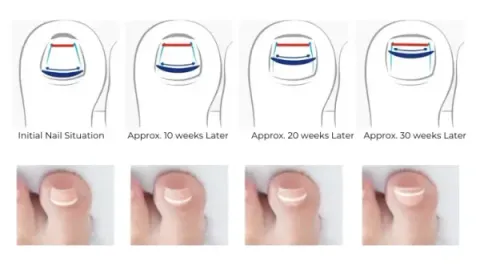
A composite band is bonded onto the nail and gently guides it flatter as it grows. No anaesthetic, no cutting, nothing to recover from, and it does not hurt to apply. It works well for nails that are curving inwards but are not badly infected.
$100 per application, plus the $125 initial assessment.
The surgical option: nail surgery
A partial nail avulsion under local anaesthetic is the more reliable fix where the nail keeps becoming infected or has already done so repeatedly. It is a single appointment, and the toe is usually tender for a day or two afterwards.
It is done in this building rather than referred on, and the post-operative check is included in the fee.
$400, post-operative check included, plus the $125 initial assessment.
The timeline is the trade-off: correction happens over months as the nail grows, where surgery resolves it in one appointment.
Which one suits you depends on the nail, not on preference: the podiatrist will tell you which at the assessment, and say so if neither is needed yet.
What your health fund pays
Nail surgery claims on any extras policy that includes podiatry; ONYFIX is billed as a consultation, so what your fund pays follows your podiatry cover. You are not committed to either until the podiatrist has looked at the nail.
The problems seen most, and what usually helps
 Heel pain and plantar fasciitis
 The recognisable sign is the first few steps in the morning, or after sitting, sharp pain under the heel that eases as you walk and returns after rest. Treatment combines calf and foot loading, footwear or orthotic support, and shockwave therapy where it has not settled with those.
 Ingrown toenails that keep coming back
 A one-off ingrown nail is usually resolved by clearing the offending edge and changing how the nail is cut. A nail that becomes infected repeatedly is a different problem. The nail's shape is driving it, and treating each episode separately resets the clock.
 Diabetic foot checks
 Diabetes reduces circulation and sensation together, which is what makes small problems serious, a blister or a cut may not be felt, and heals more slowly once it happens. The assessment checks pulses, tests sensation with a monofilament, and sets a risk category and a review interval.
 Bunions, hammer toes and forefoot changes
 The bump is the first toe joint changing position, and it is usually not the painful part, load moving across the rest of the forefoot is. Most of it is managed with footwear width, offloading and padding, with surgery worth exhausting the alternatives first.
 Morton's neuroma and ball-of-foot pain
 Burning or numbness between the third and fourth toes, often with the sensation of standing on a pebble or a folded sock, and usually worse in a narrow shoe. Width across the forefoot and offloading the irritated nerve do most of the work.
 Thickened and fungal toenails
 Several different things produce a thick, yellowing nail and they look alike, so the first job is working out which one it is. Where it is fungal, the timeline is set by how fast a nail grows rather than by the treatment.
 Corns, calluses and hard skin
 Skin thickens where it is loaded repeatedly, so removing a corn without changing the load means it rebuilds. Removal is painless and immediate; the footwear change or the offloading is what decides how quickly it returns.
 Flat feet, high arches and orthotics
 A flat foot is not automatically a problem, and plenty of them never need anything. Where the assessment shows load is going somewhere it should not, an orthotic device redistributes it, and where it does not, you are told so and you leave without one.
Fees, health funds and referrals
No referral is needed for a standard podiatry appointment. Medicare covers podiatry only through a Chronic Condition Management plan arranged by a doctor, which allows up to five allied health visits per calendar year across all providers combined, and still leaves a gap, since the rebate does not cover the full fee.
Podiatry claims on any extras policy that includes it, with the rebate depending on your level of cover and remaining annual limit, and we claim on the spot with all major funds, so you pay the gap on the day. Orthotics usually sit under a separate limit, so that is the one worth checking with your fund before ordering.
How Medicare care plan claiming works · See current fees and opening hours
Podiatry in Melbourne: what you get here
Brunswick Health is about six kilometres north of the Melbourne CBD, with parking directly out front, appointments six days a week and no referral needed. Four things are worth knowing about what happens once you are in the room.
- Nail surgery is done in this building. An ingrown toenail is assessed and treated under local anaesthetic, usually in the same appointment, with the post-operative check included, rather than assessed here and sent somewhere else for the procedure, which means a second waiting list and a second initial fee.
- There is a non-surgical option. ONYFIX correction is a composite band bonded to the nail that guides it flatter as it grows: no anaesthetic, no cutting and nothing to recover from. It is offered here, so an ingrown nail is a decision between two treatments rather than a single route.
- Orthotics follow the findings. They are prescribed to change something specific, from a foot scan and a biomechanical assessment done on site. If the assessment shows you do not need them, you are told so and you leave without them.
- When the foot is not the cause, the answer is along the corridor. Recurring foot and heel pain is often driven by load coming down from the hip or the calf. The physiotherapists and chiropractors work in this practice, so that becomes a conversation between two practitioners in the same building rather than a referral out and a fresh start somewhere else.
Shockwave therapy, biomechanical assessment and foot scanning are all on site as well, and we claim with all major health funds at the counter, so you pay the gap on the day.
How cross-discipline collaboration keeps your care moving
At Brunswick Health, seven allied health services work together under one roof, podiatry, chiropractic, physiotherapy, massage, naturopathy, acupuncture and colonic irrigation.
The benefit for you is simple: if your assessment shows that another practitioner here is better suited to help, you do not need to start over somewhere else. There is no searching for another clinic, no long wait for a new appointment, and no need to repeat your entire health history. The practitioners here can communicate directly and work together to provide more coordinated care.
Examples of how this helps
- Heel pain that is not just a foot problem, the podiatrist and physiotherapist here can work together to assess whether the cause is biomechanics, movement patterns, strength or load management.
- A foot that keeps loading badly because of what the hip is doing. Your podiatrist can identify this during the gait assessment and coordinate care with the chiropractors and physiotherapists here.
- A running injury needing more than one approach, gait assessment, shockwave therapy and rehabilitation, arranged between practitioners in the same building rather than across three.
You get the right practitioner at the right time, without repeating your history or joining another waiting list: the practitioners here can talk to each other directly, so your care keeps moving.
What people say about the clinic
4.9403 Google Reviews
Rated 4.9 out of 5 from 403 Google reviews.These reviews describe the experience of visiting the clinic. This is a registered health profession, so we are not permitted to publish comments about treatment or its results, those are on our Google listing.
“Brunswick Health is a place where you come to a positive environment, get looked after just like your Grandmother would, and get treated like a friend.”
Andrew SotiGoogle review “Very professional, always taking time to explain. The reception staff are very friendly and booking appointments is quick and easy.”
Darren MooreGoogle review “Everything just feels right, well above expectations from start to finish.”
Janette LeeGoogle review
Questions
Podiatry questions, answered
If your question is not here, call the clinic. The front desk can answer most of them on the spot.
Are there foot problems that should not wait for an appointment?
Yes, two of them. If you have diabetes, a break in the skin on your foot needs looking at within days rather than weeks, even a small one, and especially if it does not hurt, because reduced sensation means damage announces itself late. And go to a hospital rather than booking an appointment if you have any of the following:
- A foot that is hot, red and swelling quickly
- Redness spreading up the leg
- A fever alongside a wound on the foot
- A toe that has changed colour and gone cold
Those are infections and circulation problems, and they are measured in hours rather than days. Everything else is a normal podiatry appointment. If you cannot tell which one you have, call Brunswick Health on (03) 9380 8099 and describe it, reception will get you an answer rather than a booking.
What conditions does a podiatrist treat?
Podiatrists diagnose and treat problems of the foot, ankle and lower limb, including:
- Heel pain and plantar fasciitis
- Ingrown toenails, including nail surgery and ONYFIX correction
- Diabetic foot assessment, ulcers and circulation checks
- Bunions, hammer toes and other structural changes
- Fungal nail infections, corns and calluses
- Flat feet, high arches and gait-related problems
- Sports injuries of the foot and ankle
- Morton's neuroma and forefoot pain
- Arthritis affecting the foot and ankle
Is a podiatrist a foot doctor?
In everyday use, yes. A podiatrist is the practitioner people mean by 'foot doctor', and the one to see for heel pain, ingrown toenails, corns and calluses, diabetic foot checks and foot or ankle injuries. The precise answer is that podiatrists are AHPRA-registered health practitioners who complete a four-year degree, not medical doctors: they diagnose and treat the foot, ankle and lower limb, prescribe orthotics, administer local anaesthetic and perform minor nail surgery, but do not prescribe general medicines or carry out reconstructive foot surgery, which is a podiatric or orthopaedic surgeon's work. You do not need a referral to see one.
Do you do medical pedicures?
Yes, booked as a standard podiatry appointment. 'Medical pedicure' is a marketing term rather than a defined treatment, and what it describes is podiatric nail and skin care: nails cut back and thinned, corns and calluses removed rather than filed around, hard skin reduced, and anything that looks wrong picked up while you are there. It is done in a treatment room with sterilised instruments by a registered podiatrist, so unlike a salon pedicure it can be claimed on private health extras cover. There is no polish and no foot spa.
Do I need a referral to see a podiatrist?
No. You can book a podiatrist directly. A GP referral is only needed if you are claiming under a Medicare Chronic Disease Management plan, which covers a limited number of allied health visits per calendar year for people with an eligible chronic condition.
Can I claim podiatry on Medicare?
Only through a Chronic Disease Management plan arranged by your GP, which covers up to five allied health appointments per calendar year across all providers combined. That rebate does not cover the full fee, so there is still a gap. Everyone else claims through private health extras cover, which Brunswick Health processes on the spot.
Is podiatry treatment painful?
Most podiatry treatment is comfortable, and much of it, nail care, callus removal, orthotic fitting, is painless. Nail surgery is performed under local anaesthetic, so the procedure itself is not painful, though the toe is usually tender for a day or two afterwards.
How many podiatry appointments will I need?
It varies with the problem. Routine nail and skin care is often a single appointment repeated every six to twelve weeks. Heel pain or a gait-related injury is usually an initial assessment plus two or three reviews over a couple of months. Nail surgery is one procedure appointment plus a short review.
What happens at a first podiatry appointment?
The podiatrist takes a history, examines the foot and ankle, and, where the problem is movement-related, watches how you walk and how your foot loads. You are told what is causing the problem and what the options are, and treatment usually begins in the same appointment.
Do podiatrists perform surgery?
Podiatrists perform minor nail and skin surgery in the clinic under local anaesthetic, most commonly partial nail avulsion for a recurring ingrown toenail. Bone and joint surgery, such as bunion correction, is done by a podiatric or orthopaedic surgeon, and your podiatrist can refer you if that is what is needed.
What is ONYFIX and how is it different from nail surgery?
ONYFIX is a non-surgical way of correcting an ingrown or over-curved toenail. A composite band is bonded to the nail and gently guides it into a flatter shape as it grows out. There is no anaesthetic, no cutting and no recovery time, and it is painless to apply. It suits nails that are curving inwards but not badly infected; where there is significant infection or the problem keeps recurring, nail surgery is usually the more reliable fix.
Do you treat diabetic feet?
Yes. Diabetes affects circulation and sensation in the feet, which means small injuries can go unnoticed and heal slowly. A diabetic foot assessment checks blood supply, nerve sensation and skin integrity, and establishes how often you should be reviewed. People with diabetes are generally advised to have their feet checked at least annually, and more often if circulation or sensation is already reduced.
Should I see a podiatrist or a physiotherapist for my foot problem?
As a rule of thumb: if the problem is in the foot itself, the nails, skin, arch, heel or forefoot. Start with the podiatrist. If it is higher up the chain, or the foot pain came with a knee, hip or back problem, start with the physiotherapist. Both work at Brunswick Health, so if the first choice turns out to be the wrong one you can be moved across without a new referral.
Are podiatrists registered in Australia?
Yes. Podiatrists are registered with AHPRA through the Podiatry Board of Australia and must hold an approved qualification and meet annual registration standards. You can look up any practitioner's registration on the AHPRA public register.
What is the difference between podiatry and chiropody?
In Australia they refer to the same profession, chiropody is simply the older term, and the title changed to podiatry decades ago. Anyone practising foot care here today is a registered podiatrist.
Can I see a podiatrist while pregnant?
Yes, and it is a common time to need one. Weight changes and fluid retention often bring on arch and heel pain, and reaching your own feet becomes difficult, so routine nail and skin care is frequently a reason to book. Positioning is adapted for comfort later in pregnancy.
Is podiatry covered by private health insurance?
Podiatry claims on any extras policy that includes it, with the rebate depending on your level of cover and remaining annual limit. Brunswick Health claims on the spot with all major funds, so you pay only the gap on the day. Orthotics are often covered under a separate limit, worth checking with your fund before ordering.
Getting here
Finding us in Brunswick
The clinic is at 1/68 Melville Road, Brunswick West, on the Brunswick border, a few minutes from Sydney Road and the Brunswick shopping strip. If you are searching for a podiatrist in Brunswick, this is the practice most locals mean.
Open directions in Google Maps
By tram, train or car
- Route 58 tram along Melville Road. Stop 35, at Victoria Street
- Upfield line: Brunswick and Anstey stations are a short ride away
- Street parking out front, the opposite side of Melville Road is unrestricted at any hour, the clinic side from 9am on weekdays
Opening hours
- Monday – Friday
- 8:45am – 7:00pm
- Saturday
- 8:45am – 4:00pm
Closed Sunday and public holidays
Patients travel to us for podiatry from across Melbourne's inner north, most often from Brunswick, Brunswick East, Brunswick West, Coburg, Moonee Ponds, Pascoe Vale, Essendon, Thornbury and Avondale Heights.
Bookings
Get your feet looked at
Heel pain, ingrown toenails, orthotics and diabetic foot checks, with nail surgery done here in the clinic rather than referred out.
No payment needed to book · Confirmation by SMS · No referral needed
Whether it started last week or you have been walking around it for years, your podiatrist will take the time to work out what is actually causing it, explain it in language that does not need decoding afterwards, and treat it in the same appointment wherever that is the right thing to do. Feet in every condition come through this room every day.
Or call (03) 9380 8099 and reception will find you the earliest time.