
Colonic irrigation
Colonic irrigation in Brunswick
A closed-system colonic in a private room with its own ensuite, with a qualified therapist beside you for the whole session. No odour, no mess, and nothing you have to manage yourself.
See what happens during a real session.Watch the full 3-part video series below.
- A full hour booked
- Therapist present throughout
- Private ensuite room
- Single-use tubing
Common reasons people book a colonic
These are the most common reasons people come in for colonic irrigation.
- Constipation
- Bloating & heaviness
- IBS symptoms
- Sluggish digestion
- SIBO support
- After antibiotics
- Reducing laxative reliance
- Trapped wind
- Hormonal bloating
- Low energy with digestive symptoms
Show 9 more reasons
- Fluid retention
- Skin flare-ups linked to digestion
- Diverticular disease, once settled and cleared
- Naturopath-guided gut care
- Medication-related sluggish digestion
- Post-chemotherapy recovery, once your oncologist is satisfied
- Resetting healthy habits
- Before a holiday or special event
- Finally giving it a try
A colonic is a comfort and wellbeing treatment rather than a medical one, and wanting to feel lighter is a perfectly good reason on its own. Where what you describe is really naturopathic work, SIBO, hormones, or fatigue that has been going on a while, that naturopath is down the corridor, two of them also run the colonics here, and we will say so rather than book you in and leave it at that.
Or call (03) 9380 8099 and reception will find you the earliest time.
Why choose Brunswick Health?
A qualified therapist with you throughout
Closed-system, so someone stays in the room for the whole session, adjusting temperature and pressure, massaging the abdomen, and able to pause or stop at any point.
A private room with its own ensuite
Your own bathroom off your own room, so there is no corridor to walk and nobody to pass. It is the practical detail first-timers ask about most.
Single-use tubing, every time
Opened in front of you and disposed of afterwards. Ask any clinic this question directly. The answer should be immediate and unambiguous.
Four qualified therapists
Two of them are also qualified naturopaths and two hold diplomas in remedial massage, which matters in a field with no government registration scheme and no one checking training.
Seven disciplines, one booking system
Most places offering colonics do only colonics. Reception books your colonic and anything else you see us for on the same system, so you can put them in one trip.
Open six days a week
Monday to Saturday, including weekday evening appointments, so you can book around work and training.
- On Melville Road since
- 1990
- People through the practice
- 65,000+
Your colonic therapists
Choosing a colonic therapist matters. The therapists here hold additional health qualifications, including naturopathy and remedial massage, alongside their colonic irrigation training.
Not sure who is right for you? Call reception on (03) 9380 8099 and we can recommend a therapist who regularly treats people with concerns like yours.

Sara Canney
Colonic Therapist & Naturopath
Australian Traditional Medicine Society (ATMS)(opens in a new tab) · Provider 089322CL

Carmen Farrugia
Fertility & Pregnancy Naturopath, Colonic Therapist
AHPRA-registered midwife NMW0001034617
Vanessa Bruce
Remedial Massage Therapist & Colonic Therapist
Australian Natural Therapists Association (ANTA)(opens in a new tab) · Provider 1467214H

Kass Sidley
Colonic Hydrotherapist
Massage Association of Australia (MAA)(opens in a new tab) · Provider A199221L · Member 200590
What happens during your appointment
A full hour is booked for you. The treatment itself takes around 30–40 minutes, with time afterwards to use the toilet and allow your body to settle. You’re never rushed through the appointment.
Once your booking is confirmed, we’ll email you How to Best Prepare for a Colonic , what to eat beforehand, how much water to drink and what to wear. It’s short, practical guidance to help you get the most comfortable and effective session possible.
Or call (03) 9380 8099 and reception will find you the earliest time.
Have a question before you book? Call (03) 9380 8099. We’re used to talking about colonic irrigation and are happy to answer your questions, nothing is awkward or off-limits.
Checking a colonic is right for you
Your therapist starts with your health history, medications and anything else that could affect whether a colonic is appropriate for you that day. They go through any relevant contraindications with you rather than leaving you to work them out from a form.
Your own private room
You have a private room with its own ensuite. You undress from the waist down in privacy and are covered throughout the treatment. Your therapist explains everything before you begin, so you know exactly what to expect.
The treatment begins gently
A small, single-use tube is inserted gently while your therapist talks you through what is happening. This is often the part first-time clients worry about most, and it is over in just a few minutes.
Around 30–40 minutes of gentle water flow
Warm, filtered water flows gradually through the bowel and back out again in a closed system. Your therapist stays with you, adjusting the flow and pressure and using gentle abdominal massage where appropriate. You may feel fullness, movement or the urge to open your bowels, and some people experience brief cramping as the bowel responds. It should not be painful, if anything feels uncomfortable, tell your therapist and they can adjust or stop the treatment.
Take your time afterwards
Your private ensuite is right there in the room, so you can use the toilet afterwards without rushing or walking through a communal area. There is no mess or odour, the waste passes directly through sealed tubing into the sewer.
What to expect afterwards
People respond differently. You may feel lighter or less bloated afterwards, while some people feel tired for a few hours. Your therapist will explain what to eat and drink that evening and whether any further treatment is appropriate for you.
A closed system, with your therapist throughout
This is a closed-system colonic, which means your therapist remains with you throughout the treatment rather than leaving you to manage it yourself.
They control the water flow and pressure, provide abdominal massage where appropriate, and can pause or stop the treatment whenever needed. Waste travels through sealed tubing directly into the sewer.
For a first colonic, having an experienced therapist there to explain what’s happening can make the whole experience feel much more straightforward than you may have imagined.
What a colonic is for
A colonic is a wellbeing treatment intended to help empty the lower bowel. People commonly book because they want to feel less bloated, more comfortable or more regular.
It is not a treatment for disease, and not a substitute for investigating a persistent change in bowel habits. If something about yours has changed, tell us, that needs looking into first, and we will refer you rather than book you in.
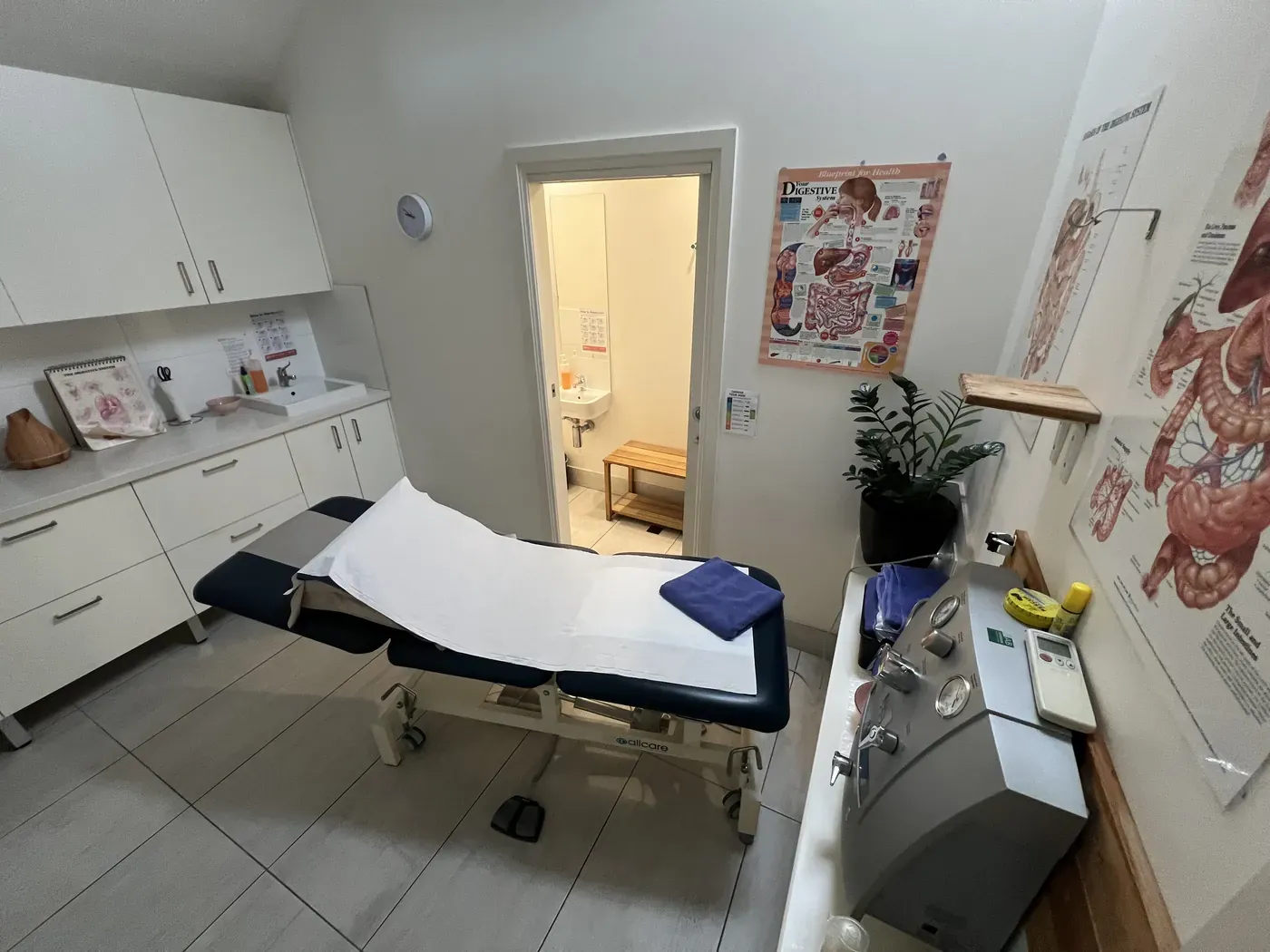
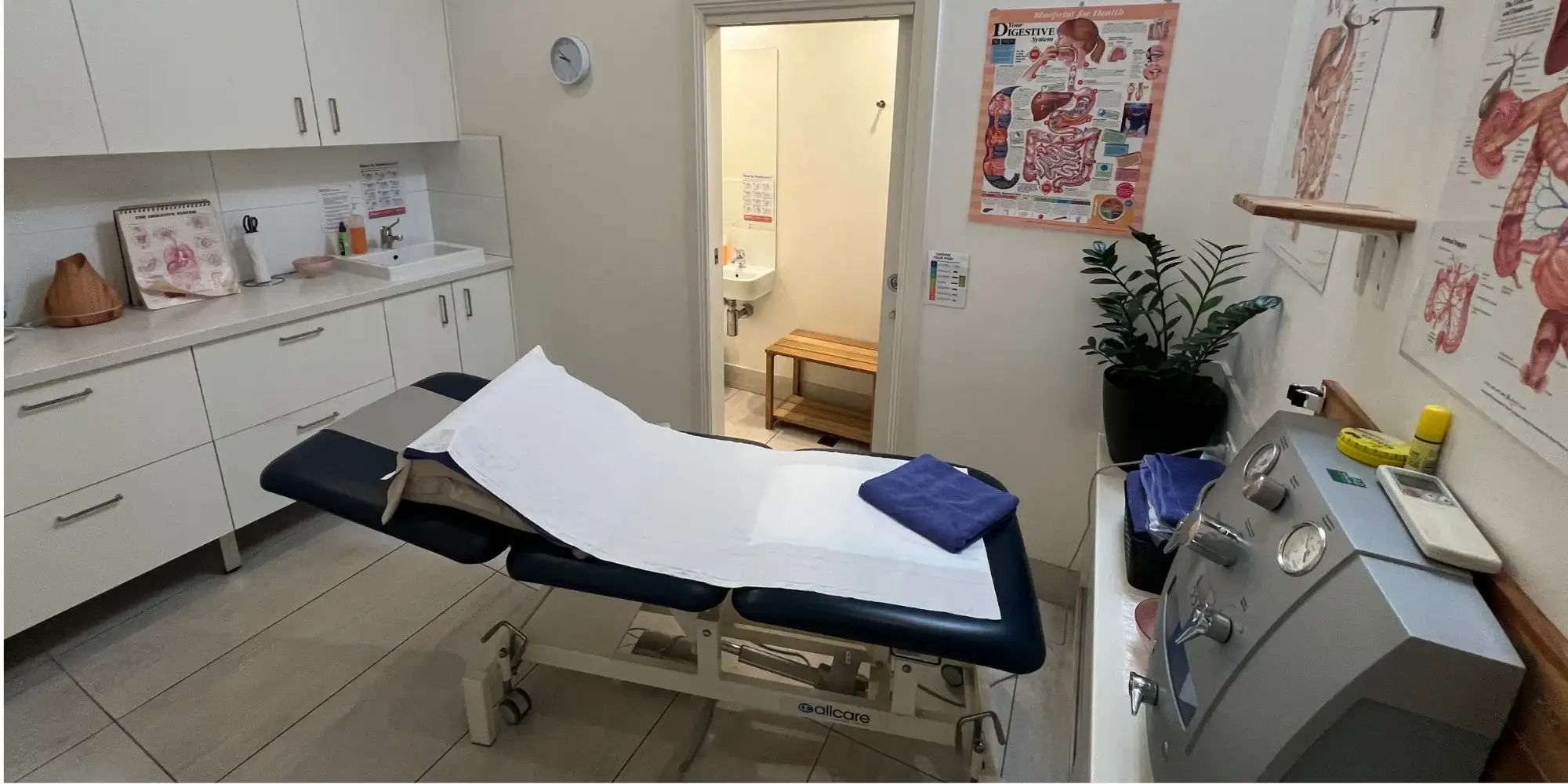
A colonics room, with its ensuite through the door. 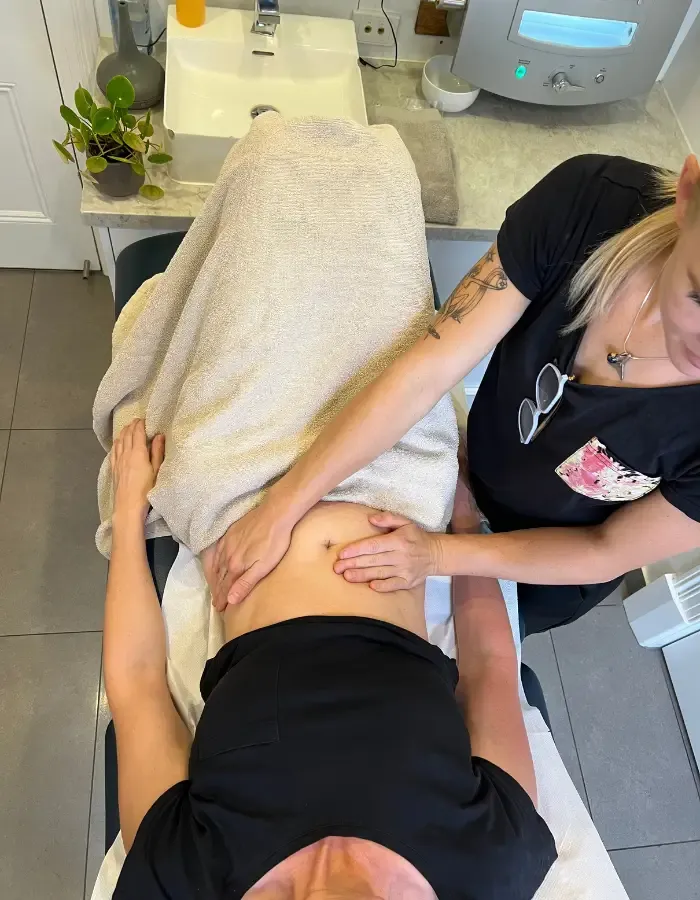
Abdominal massage through the session, part of why a therapist stays in the room.
See the room and the equipment
Still trying to picture what a colonic actually involves? These short videos show you the equipment in the treatment room, with a therapist explaining what is happening as you watch.
What to look for when choosing a colonic clinic
Not all colonic treatments are delivered in the same way. Four things are worth asking about, and this is where the clinic stands on each:
- 1. Open or closed system. In a closed system, your therapist stays with you throughout the treatment, controlling the water flow and pressure. In an open system, you are generally left to manage the treatment yourself.
- 2. Your therapist’s qualifications. Ask who will be treating you and what training or qualifications they have. Colonic irrigation is not a government-registered health profession in Australia, so training and experience can vary between clinics.
- 3. Single-use equipment. Ask whether the tubing used for your treatment is single-use. Here, the tubing is disposable and replaced for every client.
- 4. Be wary of claims about parasites. Long, thin strands or string-like material can be a normal part of bowel contents. If a clinic tells you these are “parasites” or “critters” being removed, be cautious. A colonic cannot diagnose a parasitic infection from what appears in the waste, and presenting ordinary bowel material as proof of parasites is misleading. More on colonics and parasites
The same applies to claims that colonics can detoxify your blood, boost immunity or treat disease. A clinic should be straightforward with you about what a colonic is for and where it stops.
A claim like that can be reported, and not being a registered profession does not put a clinic out of reach. The Health Complaints Commissioner(opens in a new tab) takes complaints about health service providers in Victoria, including those in professions with no registration scheme, under its Code of Conduct for General Health Service Providers. A misleading claim can also be reported to Consumer Affairs Victoria(opens in a new tab) or the ACCC(opens in a new tab) under the Australian Consumer Law.
Why people travel to Brunswick Health
Colonic irrigation has been available at Brunswick Health for around 15 years. The colonic hydrotherapists here also hold additional health qualifications, including diplomas in naturopathy and remedial massage.
Their training extends beyond colonic irrigation itself, giving you a therapist who understands the wider context of your health, can recognise when a colonic may not be appropriate, and knows when another health professional should be involved.
People come from Brunswick and Melbourne’s inner north, while others travel from the CBD, northern and western suburbs for the private rooms, closed-system treatment and experienced, therapist-led approach.
Optional infusions
Where one is appropriate, an infusion adds $30 to a follow-up session. Evidence that they deliver specific health benefits beyond the colonic itself is limited, so they are offered as an optional extra rather than as a treatment, and no session needs one. More about infusions

Coffee
The most requested addition, and the one most people have heard of.

Probiotic
Chosen by people who want to follow a colonic with something reintroduced.

Turmeric
Selected for its warmth and for personal preference.

Alkalising greens
A plant-based blend added to part of the session.
Fees, health funds and referrals
A session is $150, whether it is your first or your tenth, there is no higher initial fee here. An optional infusion adds $30. No referral is needed.
Colonic irrigation cannot be claimed on private health insurance, because there are no fund item codes for it. Worth being plain about what that means: for most people $150 is the amount you pay, not a gap left over after a rebate.
Plan-based funding works differently, because it is not tied to fund item codes. Some NDIS and aged care plans may cover colonic irrigation. Check with your plan manager or aged care provider before you book, and we can invoice accordingly. Separately, where your therapist is also a qualified naturopath, a naturopathy consultation is its own appointment and may attract a rebate depending on your fund.
Colonic irrigation, colon cleanse, colon hydrotherapy
These are all names for the same water session, and which one you searched for probably says more about where you first heard of it than anything else. Colon irrigation, colonic hydrotherapy, colon wash-out and colon flush describe it too. Nothing about what happens in the room changes with the name.
One distinction is worth making, because it is the one that catches people out. Colon cleanse is also the name given to powders, teas, capsules and ten-day kits you take at home. Those are a different thing entirely, they work by moving your bowel with laxative ingredients, and some are harsh enough to leave you worse off. A colonic here uses warm filtered water and nothing else. There is nothing to swallow, nothing to buy afterwards, and no preparation kit.
How cross-discipline collaboration keeps your care moving
At Brunswick Health, seven allied health services work together under one roof, colonic irrigation, naturopathy, chiropractic, physiotherapy, podiatry, massage and acupuncture. Most places offering colonics do only colonics.
The benefit for you is simple: if what you describe turns out to suit a different discipline better, you do not need to start over somewhere else. There is no searching for another clinic, no long wait for a new appointment, and no need to repeat your entire health history. The practitioners here can communicate directly and work together to provide more coordinated care.
Examples of how this helps
- Bloating that turns out to need investigating rather than a session, reception hears it at the enquiry, and you are pointed at the right thing instead of booked in and sent away afterwards.
- A digestive pattern that keeps returning, two of the therapists here are also qualified naturopaths, so the same person can run the colonic and take the longer view in a consultation.
- A colonic added to a trip you were already making for something else, booked on the same system rather than as a second afternoon in another suburb.
You get the right practitioner at the right time, without repeating your history or joining another waiting list: the practitioners here can talk to each other directly, so your care keeps moving.
What people say about the clinic
4.9403 Google Reviews
Rated 4.9 out of 5 from 403 Google reviews.Real, unedited reviews from our Google listing. Nothing here is written by us.
“Vanessa you're the bomb! From one colonic hydrotherapist to another, thank you for an awesome treatment today. Technique is spot on, comfortability and compassion is perfect!”
Vesna NovakovicGoogle reviewLocal Guide “Very professional, clean, friendly. The results I have had from colonic hydrotherapy have been amazing. I feel like I now have a new life.”
Ellie O'BrienGoogle reviewLocal Guide “I've been seeing the team at Brunswick Health for nearly 3 years. They've been instrumental in managing my chronic health problems, especially Sara and Vanessa. I cannot thank these women enough for how they've helped me through hard times. Illness is more than just physical and the team at Brunswick Health have never failed to provide attentive, thorough and holistic treatment. A special mention also goes to Bree at reception, her warmth, kindness, and professionalism help create such a welcoming environment from the moment you walk through the door.”
Honor RushGoogle review
Questions
Colonic irrigation questions, answered
If your question is not here, call the clinic, the front desk answers most of these every day, and nothing about the conversation needs to be awkward.
What is colonic irrigation?
Colonic irrigation, also called colonic hydrotherapy or a colon cleanse, introduces warm, filtered water into the large bowel through a small disposable tube, softening and flushing out its contents. The treatment runs thirty to forty minutes inside an hour-long appointment, with the water flowing in and out gradually rather than all at once, and a therapist present throughout to control temperature and pressure and to massage the abdomen. The water is generally kept warm, with temperature and pressure controlled case by case. Alternating between warmer and cooler water is a treatment technique in its own right. It stimulates peristalsis, the muscular wave that moves everything through the bowel, and it is a clinical decision rather than part of every session.
Is a colonic the same as a colon cleanse?
Colon cleanse, colon hydrotherapy, colon irrigation, colon wash-out and colonic irrigation are all names for the same water-based session, nothing about it changes with the name. The one thing worth separating is that 'colon cleanse' is also used for powders, teas, capsules and ten-day kits taken at home. Those work by moving the bowel with laxative ingredients and are a different thing entirely. A colonic at Brunswick Health uses warm filtered water and nothing else: nothing to swallow, no preparation kit, and nothing to buy afterwards.
What does it actually do?
It empties the large bowel more completely and more gently than a laxative, which most people experience as relief from bloating, heaviness and sluggishness. That is what the procedure does and what people book it for. It is a comfort and wellbeing treatment rather than a medical one. It does not detoxify the blood, treat disease, or replace medical investigation of a bowel problem. If you have symptoms that need diagnosing, tell us. Digestive complaints are everyday naturopathic work and the naturopaths here can arrange the pathology to look into them properly; if specialist care is the next step, we'll provide a detailed letter outlining our findings and recommendations, including the specialist we believe is best suited to your needs, helping ensure a smooth transition to the next stage of your care.
What is a closed system, and why does it matter?
In a closed system a qualified therapist is with you for the whole session, and waste passes through sealed tubing directly into the sewer, so there is no odour, no mess and nothing to manage yourself. In an open system you are left alone to self-administer. Brunswick Health uses a closed system: the therapist adjusts water temperature and pressure as they go, performs abdominal massage, and can stop or change anything at any point.
Does a colonic hurt?
It should not. Most people describe the sensation as fullness that comes and goes in waves, similar to the feeling before a bowel movement, sometimes with brief cramping as water moves through. The therapist adjusts pressure and temperature continuously, and the session can be paused or stopped whenever you ask. Tell your therapist if anything is uncomfortable, that is what they are there for.
Who does colonic irrigation suit?
Most healthy adults, and there is a short list of things worth raising first. Tell the front desk before booking if any of these apply to you. We screen for all of them, and will refer you rather than book you in where a colonic is not the right step:
- Pregnancy
- Recent bowel, abdominal or rectal surgery
- Active inflammatory bowel disease, including Crohn's disease and ulcerative colitis, during a flare
- Diverticulitis during an active episode
- Severe haemorrhoids, anal fissures or rectal bleeding
- Bowel cancer, or any undiagnosed change in bowel habit
- Chemotherapy, during active treatment, and afterwards until your oncologist confirms you are clear to go ahead
- Severe uncontrolled high blood pressure, heart failure or kidney disease
- Recent heart attack or stroke
If you are not sure, call and ask. It is a short conversation, and the front desk has it every day.
How should I prepare?
Eat lightly on the day and avoid a heavy meal in the two to three hours beforehand. Drink water through the day. It helps to avoid alcohol and fizzy drinks for 24 hours before, and to wear comfortable clothing. You do not need to fast, and you do not need to take a laxative first.
How will I feel afterwards?
Most people feel lighter and less bloated, and some feel tired for a few hours. Your bowel habit will usually take a day or two to settle back into its normal rhythm, since the bowel has been emptied more completely than usual, that is expected and not a cause for concern. Drink plenty of water and eat something simple for your next meal.
How many colonic irrigation sessions will I need?
Many people book a single session and are satisfied with it. Others prefer a short series, or an occasional session every few months. There is no clinical schedule you need to follow, and no course you need to commit to. Your therapist will tell you if there is no reason to come back.
Can a colonic reach the ascending colon and hepatic flexure?
Colonic irrigation works with the whole large bowel, so the ascending colon and the hepatic flexure, the bend at the top right, where the colon turns to cross the body, are both within reach. That is what separates it from an enema, which only reaches the rectum and sigmoid at the very end. Reaching an area and clearing it are two different things, though: where faecal loading is long-standing it usually takes a number of sessions to work around to the ascending colon, because what sits closer to the exit clears first, and how heavily loaded the bowel is overall decides how long that takes. Your therapist will advise on the next steps after your first session, working with your health history, diet and daily routine alongside what they see on the day.
Mention the pain you are describing when you book. Abdominal pain that has not been looked into is one of the things screened for before a colonic, and it may change what your therapist recommends.
Can I have a colonic during my period?
Yes. It is perfectly safe and reasonably common, and some people find it eases period-related bloating. Mention it when you arrive so your therapist can make you comfortable.
Can I have a colonic while pregnant?
No. Colonic irrigation is not performed during pregnancy at this clinic. If you are pregnant and constipation is the problem, tell us. We will refer you to your GP or midwife for options that are safe in pregnancy.
Can children have colonics?
No. Colonic irrigation is not provided to children at this clinic. Bowel problems in children should be assessed by a GP or paediatrician.
What are colonic infusions?
An infusion adds a substance to the water during part of the session. The options here are coffee, probiotic, turmeric and alkalising greens. For safety they are not offered on a first visit: your therapist sees how you respond to a standard colonic first, and raises an infusion at a later appointment if they judge one appropriate for you. Evidence that infusions produce specific health benefits beyond the colonic itself is limited, so they are offered as an optional addition rather than as a treatment, and no session depends on one.
Do colonics remove parasites?
There is no good evidence that a colonic clears a parasitic infection, and it is not used as a treatment for one. It is also not a way of finding one: most intestinal parasites are microscopic and are identified from a stool sample in a laboratory, so nothing passing a viewing tube during a session is offered here as a diagnosis. What a colonic does is empty the large bowel, which people book for bloating, heaviness and sluggishness. If a parasite is your actual concern, tell us. The naturopaths here can arrange that pathology through a private laboratory, paid directly to the lab without a Medicare rebate, and we'll refer you for the prescription where a result calls for one.
Is a colonic the same as colonoscopy preparation?
No. Colonoscopy preparation is a prescribed oral regimen designed to empty the bowel completely for a medical procedure, and colonic irrigation is not a substitute for it. If you are booked for a colonoscopy, follow the preparation instructions your specialist gave you.
Do I need a referral?
No referral is needed. You can book directly, and your first appointment includes a consultation about your health history before anything begins.
Is colonic irrigation covered by private health insurance?
Generally not. There are no health fund item codes for colonic irrigation, so funds do not pay a rebate on it. Where one of the colonic therapists here is also a qualified naturopath, a naturopathy consultation may attract a rebate depending on your fund and level of cover, but the colonic itself normally will not. Check with your fund rather than assuming.
Are colonic hydrotherapists registered in Australia?
There is no government registration scheme for colonic irrigation in Australia, which means the standard of training varies considerably between clinics, worth knowing when comparing providers. The therapists here are qualified in colonic hydrotherapy, two are also qualified naturopaths, and two hold diplomas in remedial massage. You are welcome to ask about any therapist's specific training before booking.
What are the facilities like?
Each session is in a private room with its own ensuite, and you are never in a shared space during treatment. Disposable tubing is used once and discarded, and equipment is sterilised between clients. Waste passes through sealed tubing straight to the sewer, so there is no odour at any point.
Can I overuse laxatives?
Yes, and it is worth taking seriously. Regular use of stimulant laxatives can reduce the bowel's own responsiveness over time, and long-term dependence is a recognised problem rather than a rare one. If you are relying on laxatives to have a bowel movement, raise it with a health practitioner, your prescriber, if a laxative was prescribed, and tell us before you book. Coming off them is naturopathic work: fibre, fluid, magnesium and the motility picture underneath, which is exactly what the naturopaths here take on. Where a laxative has been prescribed, that plan is worked around rather than overridden.
Can men have colonic irrigation?
Yes. It is the same treatment whoever you are, and nothing about it is specific to one sex. You stay covered throughout, in a private room with its own ensuite, and the closed system means waste passes out through sealed tubing without ever being exposed to the room. Your therapist explains each step before it happens and adjusts the flow as you go, so nothing is done without you knowing it is coming.
Getting here
Finding us in Brunswick
The clinic is at 1/68 Melville Road, Brunswick West, on the Brunswick border, a few minutes from Sydney Road and the Brunswick shopping strip. If you are searching for a colonic hydrotherapist in Brunswick, this is the practice most locals mean.
Open directions in Google Maps
By tram, train or car
- Route 58 tram along Melville Road. Stop 35, at Victoria Street
- Upfield line: Brunswick and Anstey stations are a short ride away
- Street parking out front, the opposite side of Melville Road is unrestricted at any hour, the clinic side from 9am on weekdays
Opening hours
- Monday – Friday
- 8:45am – 7:00pm
- Saturday
- 8:45am – 4:00pm
Closed Sunday and public holidays
Patients travel to us for colonic irrigation from across Melbourne's inner north, most often from Brunswick, Brunswick East, Brunswick West, Coburg, Moonee Ponds, Pascoe Vale, Essendon, Thornbury and Avondale Heights.
Bookings
Book a colonic session
Closed-system equipment, a private room with its own ensuite, and a qualified practitioner with you for the whole session.
No payment needed to book · Confirmation by SMS · No referral needed
If you have been thinking about this for a while, the practical answers are these: you are in a private room with your own ensuite, you are covered throughout, the tubing is opened in front of you, and your therapist has done thousands of these. There is no odour at any point. Nobody at this clinic finds the topic awkward, and every session opens with a consultation where any question you still have gets answered.
Or call (03) 9380 8099 and reception will find you the earliest time.