Skip to content
(03) 9380 8099
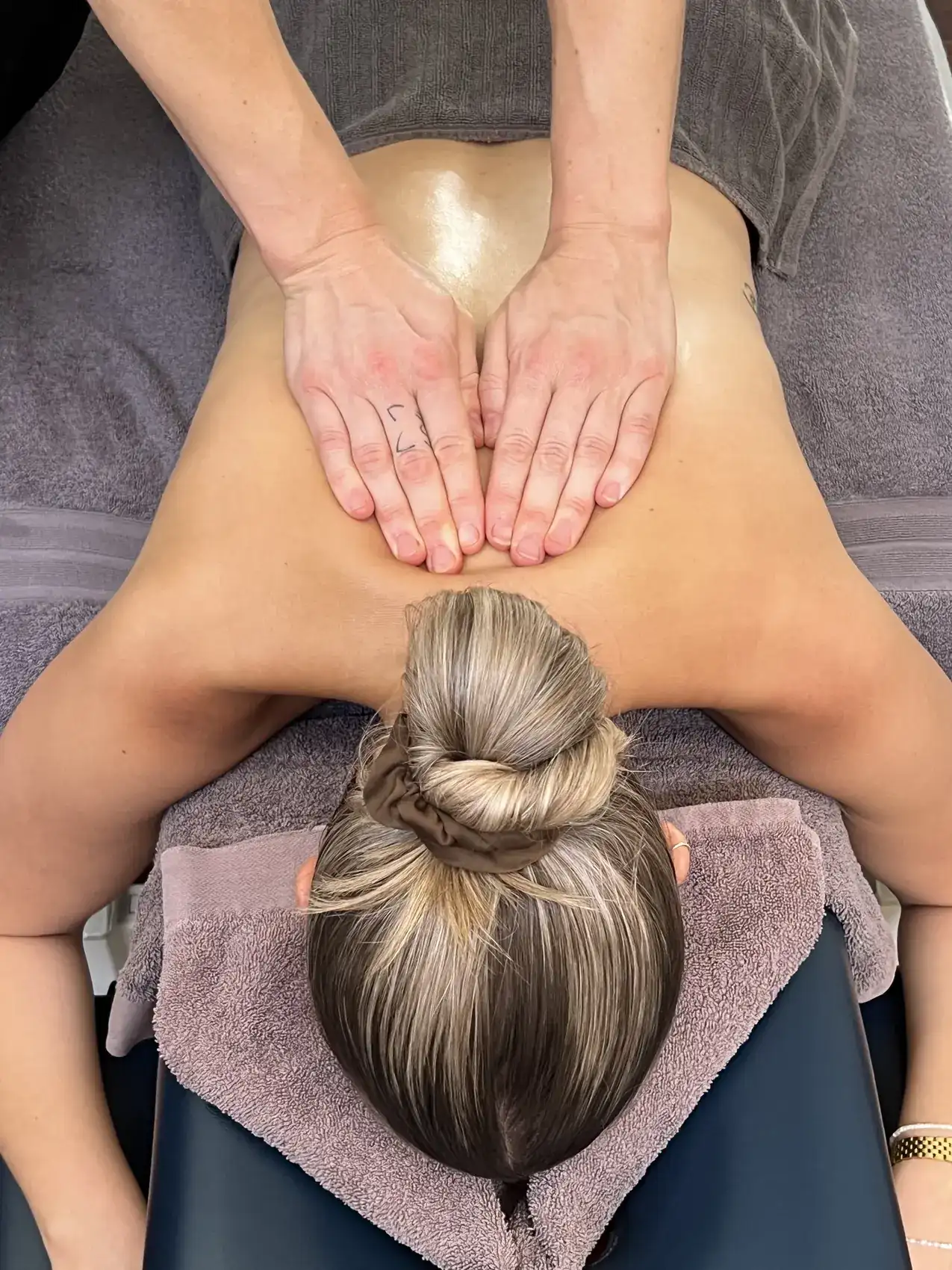
A remedial massage therapist working across a patient's upper back and shoulder

Massage & myotherapy

Remedial massage in Brunswick, Melbourne

Remedial massage, myotherapy, sports and lymphatic drainage massage from five qualified therapists — every one a member of a recognised professional association and registered with the major health funds.

  • Five therapists
  • Health-fund registered
  • Claim on the spot
  • Dry needling and cupping

What people book massage for

Whether it has been building for a week or for years, the therapists here work out what is actually tight, why it keeps getting that way, and what will hold once you leave. Most of the book is muscular tension from work, training and everyday load.

Show 8 more reasons people book

Not sure which kind of massage to book? Say what is bothering you and the front desk will match you to the right therapist. Booking the wrong type is not a problem worth worrying about — the session adapts.

Or call (03) 9380 8099 and reception will find you the earliest time.

Why choose Brunswick Health?

  • Five therapists, with different strengths

    Sports and training, pregnancy, deep remedial work, lymphatic drainage, and myotherapy where dry needling or cupping is useful. Say what is bothering you and the front desk will match you.

  • Association-qualified and fund-registered

    All five hold membership of a recognised professional association and all five are registered with the major health funds. Two separate standards, and in an unregulated industry neither is a given.

  • Every style of session claims the same

    All three session lengths are booked under one item code, so choosing a relaxation hour instead of a remedial one does not change what your fund pays.

  • Dry needling and cupping available

    From the therapists trained in them, used within a session where hands alone are not releasing something rather than booked as a separate appointment.

  • Seven disciplines under one roof

    If tightness keeps returning because something else is driving it, the chiropractors, physiotherapist and podiatrist are down the corridor rather than at another clinic.

  • Open six days a week

    Monday to Saturday, including weekday evening appointments, so you can book around work and training.

Treating in Melbourne since
1990
People through the practice
65,000+

Our satisfaction guarantee covers the service on your first visit.

Your first session

Book 60 minutes for a first remedial appointment if you can. Thirty is enough to work one area properly; it is not enough to assess a problem and treat it in the same visit.

Or call (03) 9380 8099 and reception will find you the earliest time.

  1. A few minutes to understand the problem

    Where it hurts, how long it has been there, what you do during the day and what you want to get back to doing. Anything you take matters too — including blood thinners or anything that affects clotting — so your therapist can make sure the treatment is appropriate before you get on the table.

  2. Finding what is actually causing the problem

    Your therapist may watch you move or feel around the area to work out what is contributing to your symptoms. The place that hurts is not always the place that needs attention, which is why treatment is based on what they find rather than simply where it hurts.

  3. Undressing to your comfort

    You decide what you are comfortable removing. Many people keep their underwear on, and some areas can be treated with clothing on. You undress and dress in private, you are covered with a towel throughout, and only the area being treated is uncovered. If anything needs to be moved, your therapist will ask first.

  4. The hands-on treatment

    Most of your appointment is hands-on work, using the pressure and techniques appropriate to what your therapist finds. Good remedial massage can feel firm and productive without being painful. If the pressure is too much, say so — your therapist will adjust it. You should never feel that you have to tolerate pain for the treatment to work.

  5. What your therapist found

    Before you leave, your therapist will explain what they found, how it may relate to your symptoms and what they think is most likely to help. Sometimes that is further massage; sometimes another approach or assessment makes more sense.

  6. What to do between sessions

    If there is something simple that could help — an exercise, stretch, movement or change to your routine — your therapist will show you. They will also tell you whether another session is worthwhile, including when the answer is that you do not need one, and roughly how many you are likely to need.

What treatment involves

Remedial massage here is assessment-led rather than a fixed routine. Your therapist chooses what to work on based on what they find, and adjusts the pressure and techniques to suit you. The sessions below run 30, 40 or 60 minutes, and all of them are booked and claimed the same way.

  • Remedial massage

    Assessment first, then firmer targeted work on the specific area causing trouble. This is what most people book, and what a first appointment is usually best spent on.

  • Myotherapy

    A further year of training beyond the remedial diploma, with more assessment and techniques including dry needling and cupping. Useful where a problem has not responded to massage alone.

  • Sports and recovery massage

    Built around training and competition — preparing for an event, recovering after one, or managing load through a heavy block.

  • Lymphatic drainage massage

    Light, slow, rhythmic strokes rather than deep pressure, working with the vessels that sit just under the skin. Usually booked for puffiness and fluid retention, for heavy or swollen legs, and after surgery once your surgeon has cleared hands-on work. Available from therapists trained in it — mention it when you book, and expect a far gentler hour than a remedial session. It is genuinely a different treatment rather than a different emphasis, so it has a page of its own.

    What it is, what it is for, and when you need a certified lymphoedema therapist

  • Relaxation massage

    Flowing, even pressure over the whole body, for winding down rather than fixing something. Booked, priced and claimed exactly the same way as any other session here.

  • Pregnancy massage

    Side-lying with supportive cushioning after the first trimester, most often for low back and hip discomfort. Mention the pregnancy when booking so the room is set up before you arrive.

  • Dry needling and cupping

    Available from therapists trained in them, used alongside hands-on work rather than instead of it — normally where a trigger point is not releasing with hands alone.

Fees, health funds and referrals

No referral is needed. Sessions run 30, 40 or 60 minutes, and a first remedial appointment is best booked at 60.

Massage and myotherapy claim on any extras policy that includes remedial massage, with the rebate depending on your level of cover and remaining annual limit, and we claim on the spot with all major funds. Every session here is booked under that item code, so the style of massage you choose does not change what you can claim.

See current fees and opening hours

How many sessions this usually takes

For a recent tight neck or a sore back after a heavy week, one or two sessions is often the whole story. For something that has been building for months, expect to feel a change in the first session and to need three or four before it holds on its own.

The test worth applying is whether the relief lasts longer each time. If you are three sessions in and every visit resets you to the same starting point, massage is treating a symptom whose cause is somewhere else — and your therapist should say so rather than book you a fourth. There are six other disciplines in this building, so finding the cause does not mean starting again somewhere new.

Every therapist here is association-qualified and fund-registered

All five hold membership of a recognised professional association — Massage & Myotherapy Australia or the Myotherapy Association of Australia — and all five are registered with the major health funds. Those are two separate standards, and each one is worth knowing about.

Association membership requires a recognised qualification and a code of conduct. Health fund registration has its own qualification standard, which is why a fund will pay a rebate for some therapists and not others.

Both matter more in massage than in the registered professions, because in Australia massage therapy is not government-regulated and the title is not protected. Someone with a weekend certificate and someone with a three-year degree can advertise the same service at the same price. It is a fair question to put to any clinic before you book — including this one, where the answer comes back straight away.

The things people are too polite to ask

How much you undress is up to you

Many people keep underwear on. Some stay clothed for certain work. You are covered by a towel throughout and only the area being worked on is uncovered at any time. You undress and dress in private, and if a strap is in the way your therapist will ask before moving it.

Firm should not mean painful

Good remedial work on a tight area sits between discomfort and relief — something you can breathe into. Pain does not make it more effective, and bracing against pressure actively works against the therapist. "A bit lighter" is a complete sentence and nobody will take it personally.

Falling asleep is a compliment

It happens constantly and means you relaxed properly. Your therapist will keep working and wake you at the end.

Being sore the next day is normal — mostly

A day of mild ache after deeper work is expected, like the ache after unfamiliar exercise. Water, gentle movement and a warm shower help. What is not expected is severe soreness, soreness lasting several days, or significant bruising. If that happens the pressure was too heavy — tell us, and it changes next time.

How cross-discipline collaboration keeps your care moving

At Brunswick Health, seven allied health services work together under one roof — massage and myotherapy, chiropractic, physiotherapy, podiatry, naturopathy, acupuncture and colonic irrigation.

Massage often works best beside something else. Chronic tightness that keeps returning usually has a cause — a joint that is not moving, a strength deficit, a foot that loads badly — and treating the muscle alone means treating it repeatedly. Because the other practitioners work in this same practice, your therapist can flag it and you can be seen without a new referral, a new waiting list, or repeating your history from the beginning. Equally, if massage is all you want, that is a complete answer and nobody will push you further.

Examples of how this helps

  • A neck that tightens up again within days — your therapist can flag it and the chiropractors here can look at whether a joint is driving it, without you starting again somewhere else.
  • Calf and hamstring tightness that keeps returning in a runner — the physiotherapist and podiatrist here can assess load and gait while the massage keeps the training going.
  • A booking that turns out to need assessing rather than massaging — nerve symptoms, a recent injury, an unexplained change — is redirected in one conversation rather than after an hour on the table.

You get the right practitioner at the right time, without repeating your history or joining another waiting list — the practitioners here can talk to each other directly, so your care keeps moving.

What people say about the clinic

4.9395+ Google Reviews

Rated 4.9 out of 5 from 396 Google reviews.

Real, unedited reviews from our Google listing. Nothing here is written by us.

  • “Came in to see Nikki Davis for a remedial massage. She made me feel comfortable and I received such an amazing service. Struggling with neck, back and shoulder pains — I am feeling relieved and relaxed after my service. Would recommend Nikki.”

    Stephanie JakopcevicGoogle review
  • “Brunswick Health is a place where you come to a positive environment, get looked after just like your Grandmother would, and get treated like a friend.”

    Andrew SotiGoogle review
  • “Very professional, always taking time to explain. The reception staff are very friendly and booking appointments is quick and easy.”

    Darren MooreGoogle review

Questions

Massage questions, answered

Including the ones people usually feel awkward asking at the front desk.

What is the difference between remedial, relaxation and sports massage?

Relaxation massage uses flowing, even pressure over the whole body and is about winding down. Remedial massage targets a specific problem — a tight, painful or restricted area — with assessment first and firmer, more localised work. Sports massage is remedial work oriented around training and competition, whether preparing for it, recovering from it or managing an injury. Most appointments here are remedial; say what you are after when you book and the session is built around it.

What is the difference between remedial massage and myotherapy?

A remedial massage therapist holds a Diploma of Remedial Massage and works with muscle and soft tissue. A myotherapist has completed a further year — an Advanced Diploma or Bachelor's degree — with additional assessment training and techniques such as dry needling and cupping. In practice many remedial therapists also complete bridging courses in those techniques, so the useful question is not which title someone holds but what they are trained in. Both claim on any extras policy that includes remedial massage. For most tight necks, sore backs and heavy training weeks, remedial massage is the one to start with; myotherapy earns its place where something has not responded to hands-on work alone, where the pattern keeps returning, or where you already know a trigger point needs needling. If you are not sure, book remedial and say so — your therapist will tell you if the other is the better fit, and moving between them costs you a sentence at the front desk.

Do you offer lymphatic drainage massage?

Yes, from therapists trained in it — mention it when you book. Manual lymphatic drainage is light, slow and rhythmic rather than deep, working with the vessels just under the skin, and people expecting a firm massage are often surprised at how gentle it is. It is usually booked for puffiness and fluid retention, heavy or swollen legs, and recovery after surgery once your surgeon has cleared hands-on work. Brunswick Health also offers a machine version using compression boots, booked through chiropractic or physiotherapy rather than massage; it is a different treatment and costs less. If you have had lymph nodes removed, or you have a heart, kidney or clotting condition, tell us before booking so the right call can be made.

Can anyone call themselves a massage therapist?

In Australia, yes — massage therapy is not government-regulated and the title is not protected, so training ranges from a weekend course to a three-year degree with nobody checking. Two things separate a qualified therapist from an unqualified one: membership of a recognised professional association, which requires a recognised qualification and a code of conduct, and registration with private health funds, which has its own qualification standard. Every massage therapist at Brunswick Health holds both. It is a fair question to ask any clinic, and you should expect a straight answer.

What conditions does massage therapy help with?

Remedial massage is most commonly booked for:

  • Neck, shoulder and upper back tension, particularly desk-related
  • Lower back tightness and stiffness
  • Headaches with a muscular or neck component
  • Sports and training-related muscle soreness
  • Recovery between heavy training blocks
  • General stress and muscular tension
Is massage the right thing to book for what I have?

Book a massage if any of these sound like you:

  • Muscles feel tight, achy or knotted rather than sharply painful
  • Desk work, driving or training has loaded your neck, shoulders or lower back
  • You are training hard and want to recover better or prepare for an event
  • You are pregnant past the first trimester and your hips or low back are complaining
  • You already have a diagnosis and want the muscular side of it worked on
Is anything worth mentioning before I book a massage?

A few things are better raised before you book than on the table, because they change who should see you first:

  • There is numbness, pins and needles or weakness — that is a nerve, and it needs assessing first
  • The pain followed a real injury, a fall or a crash
  • You have a fever, an infection, or unexplained weight loss
  • The same problem keeps coming back no matter how much massage you have
  • You are on blood thinners or have a clotting disorder — tell us before booking, not on the table

None of these means you cannot have a massage — most of them mean something should be looked at alongside it. Call (03) 9380 8099 and describe it, and reception will book you with whichever of the seven disciplines here should see it first. That is faster than booking the wrong thing.

Ask a practitioner in writing — answered within one business day

How should a massage feel?

Firm work on a tight area often sits somewhere between discomfort and relief — noticeable, but something you can breathe through and relax into. It should not be something you have to brace against or endure. Pain does not make a massage more effective, and tensing against pressure works against what the therapist is trying to do. Say something the moment it is too much; a good therapist would far rather adjust than have you lie there enduring it.

Do I need to take off my underwear?

No. Undress to whatever level you are comfortable with — many people keep underwear on, and some stay fully clothed for certain work. You are covered by a towel or sheet throughout, and only the area being worked on is uncovered at any time. If a bra strap is in the way, your therapist will ask before moving it. You undress and dress in private, and nothing about this needs discussing beyond a sentence.

Is it rude to fall asleep during a massage?

Not at all, and it happens often. It usually means you have relaxed properly, which is a good sign rather than an awkward one. Your therapist will simply carry on, and wake you gently at the end.

How do I tell the therapist what I want without being awkward?

Say it plainly at the start — where it hurts, how much pressure you like, anywhere you would rather they avoided. During the session, "a bit lighter there" or "more of that" is all that is needed. Therapists genuinely prefer direction to guesswork, and cannot feel what you are feeling. You are not being difficult; you are making the session work.

Why am I sore the day after a massage?

Mild soreness for a day or so after deeper remedial work is common and normal, much like the ache after unfamiliar exercise. Drinking water, moving gently and a warm shower all help. Soreness that is severe, or lasting beyond a couple of days, is not expected — mention it, and the pressure will be adjusted next time.

Why do some people get a headache after a massage?

It can happen after work on the neck and upper shoulders, and usually settles within a few hours. Being dehydrated beforehand makes it more likely, so drink water before and after. If headaches follow every massage, tell your therapist — it usually means the approach around the neck needs changing.

Why do some people bruise after a massage?

Occasional light bruising can occur after deep work, particularly if you bruise easily generally, take blood-thinning medication, or are low in certain nutrients. It should be minor and short-lived. Extensive or painful bruising is not a normal outcome and means the pressure was too heavy — tell the clinic if that happens.

Can I have a massage while pregnant?

Yes. Pregnancy massage is common and often very welcome, particularly for low back and hip discomfort. Tell the clinic you are pregnant when booking so the right therapist and setup are arranged. Positioning is adapted — after the first trimester you would normally be side-lying with supportive cushioning rather than face down.

Can I lie on my stomach while pregnant?

Generally not beyond the first trimester, even with a cut-out table or cushion. Side-lying with pillows supporting the top leg and bump is more comfortable and just as effective, and it is the standard approach here.

Can I keep training during a course of massage?

Yes. Massage fits around training rather than replacing it. It is worth avoiding a heavy or maximal session in the 24 hours after deep remedial work, since you may be a little sore — but light training, mobility and easy aerobic work are fine.

Does massage help prevent injuries?

It can contribute, mostly by keeping tightness and restriction from building up unnoticed and by giving you regular feedback on what is tight and why. It is not a substitute for the things that reliably reduce injury risk — strength work and sensible training load — and any clinic telling you otherwise is overselling it.

Is massage covered by private health insurance?

Massage and myotherapy claim on any extras policy that includes remedial massage, with the rebate depending on your level of cover and remaining annual limit. Every session here is booked under that item code, so the style of massage you choose does not change what you can claim. Brunswick Health claims on the spot with all major funds, so you pay only the gap on the day.

What professional conduct means here

The appointment is clinical from start to finish, held to the code of conduct that membership of Massage & Myotherapy Australia or the Myotherapy Association of Australia requires. In the room that looks like this: your therapist explains what they plan to work on and why before starting, you undress and dress in private, you stay covered by a towel with only the area being worked on uncovered, and you are asked before a strap is moved or a new area is included. Pressure is checked as the session goes, and "lighter", "skip that" or "stop" is acted on straight away and needs no reason. Everything done in that hour is massage work with a clinical purpose, and nothing else.

What should I do if a therapist behaves inappropriately?

A therapist is in a position of trust, and that carries clear boundaries: no sexual comments or advances, no treatment that is not clinically justified, no personal or romantic involvement with clients, and no inappropriate self-disclosure. Whether conduct was intended a certain way does not matter — what matters is whether it was unwelcome. If something concerns you, you can raise it with the clinic, with the therapist's professional association, with the police, or with Victoria's Health Complaints Commissioner on 1300 582 113 or at hcc.vic.gov.au. You do not need to be certain before you raise it.

Getting here

Finding us in Brunswick

The clinic is at 1/68 Melville Road, Brunswick West — on the Brunswick border, a few minutes from Sydney Road and the Brunswick shopping strip. If you are searching for a massage therapist in Brunswick, this is the practice most locals mean.

Open directions in Google Maps

By tram, train or car

  • Route 58 tram along Melville Road — stop 35, at Victoria Street
  • Upfield line: Brunswick and Anstey stations are a short ride away
  • Street parking out front — the opposite side of Melville Road is unrestricted at any hour, the clinic side from 9am on weekdays

Opening hours

Monday – Friday
8:45am – 7:00pm
Saturday
8:45am – 4:00pm

Closed Sunday and public holidays

Patients travel to us for massage and myotherapy from across Melbourne's inner north — most often from Brunswick, Brunswick West, Brunswick East, Parkville, Carlton, Coburg, Pascoe Vale, Pascoe Vale South, Thornbury, Moonee Ponds, Essendon, Avondale Heights and Fitzroy.

Directions, parking and contact details

Bookings

Book a massage in Brunswick

Thirty, forty or sixty minutes with one of five qualified therapists — every one an association member and registered with the major health funds.

No payment needed to book · Confirmation by SMS · No referral needed

Whether you want an hour to switch off or a therapist to find the thing that has been catching for months, you will be seen by someone who holds a recognised qualification, is registered with the major health funds, and will tell you plainly what they found and whether massage is the right answer for it.

Or call (03) 9380 8099 and reception will find you the earliest time.