
Physiotherapy
Dry needling: how it differs from acupuncture
Fine needles into muscle trigger points to reduce tension and pain. What the technique involves, what it feels like, and how it differs from acupuncture.
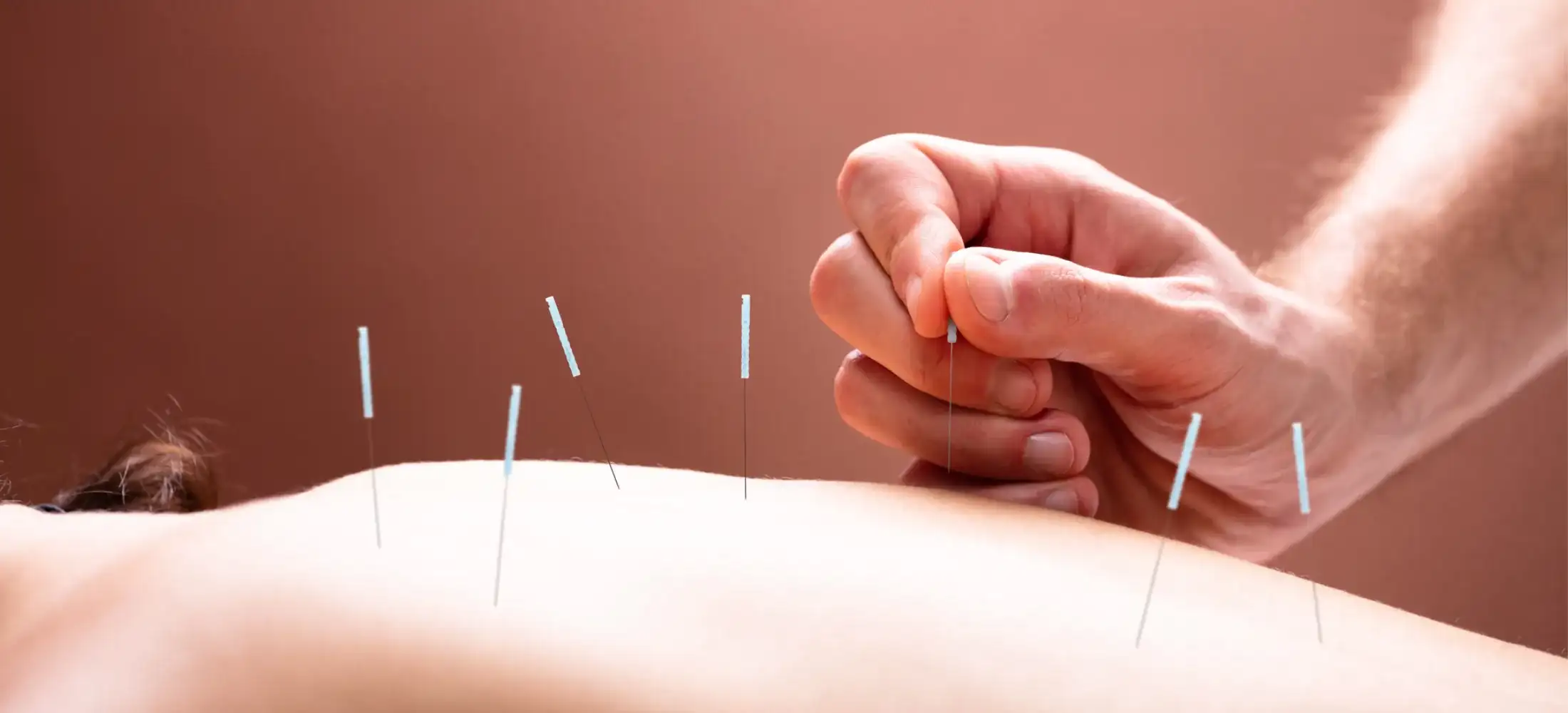
Dry needling uses fine, single-use, solid filament needles inserted into muscle to reduce tension and pain. “Dry” distinguishes it from an injection, nothing is delivered through the needle. The needle itself is the treatment.
It is used at Brunswick Health by chiropractors, physiotherapists and myotherapists as part of treatment for muscular pain, alongside hands-on work and exercise.
How it differs from acupuncture
The needles are similar. Almost everything else is not.
Acupuncture comes from traditional Chinese medicine and works from a framework of meridians and points, with needle selection guided by a diagnostic system developed over centuries. In Australia acupuncturists are AHPRA-registered through the Chinese Medicine Board, with a four-year degree behind them.
Dry needling comes from Western musculoskeletal medicine. Needles are placed into palpable trigger points in muscle, taut, tender bands that reproduce a recognisable pattern of pain when pressed. Selection is anatomical.
They can look identical from the table and are underpinned by entirely different reasoning. Both are available at Brunswick Health, and which is appropriate depends on what you are coming in for.
What a trigger point is
A discrete, hypersensitive spot in a taut band of muscle. Pressing it hurts locally and often refers pain elsewhere in a reproducible pattern, a trigger point in the upper trapezius commonly refers up the side of the neck and into the head, which is why some headaches respond to treatment of the shoulder.
Whether trigger points are exactly what the classical model describes is still debated in the literature. What is not in doubt is that these tender bands are palpable, that pressing them reproduces someone’s familiar pain, and that treating them often changes it.
What happens in a session
The practitioner locates the point by palpation, then inserts the needle through the skin into the muscle. Depth depends on the muscle.
Two sensations are common. A dull ache or heaviness, often described as a deep cramp, which usually indicates the needle is in the right place. And sometimes a brief involuntary twitch of the muscle, which is called a local twitch response and is generally taken as a good sign.
It is not usually described as sharp. The skin entry is barely felt; the ache that follows is the part people notice.
Needles may be left in place for a short period or inserted and withdrawn. A session might involve a few needles or a dozen, depending on the area.
Afterwards
Soreness for 24 to 48 hours, similar to the ache after unfamiliar exercise, is common and expected. Occasionally there is minor bruising. Heat and gentle movement help; a heavy training session immediately afterwards generally does not.
Some people feel noticeably tired or a little light-headed straight after treatment. It passes, and it is worth mentioning rather than driving off feeling odd.
What the evidence supports
The evidence is moderate rather than overwhelming, and it is strongest for short- to medium-term reduction in pain and improvement in range of movement, particularly for neck and shoulder pain and myofascial pain generally.
Where the evidence is weaker is in dry needling as a standalone treatment. The consistent finding is that it works best combined with exercise and manual therapy. It can reduce pain and tension enough to make the loading work possible, which is where the durable change comes from.
Anyone presenting it as a complete treatment on its own is overstating it.
Safety, and who should not have it
Serious adverse events are rare when performed by a trained practitioner. The most significant risk is pneumothorax when needling over the chest wall or upper back, which is why practitioners use specific safe techniques in those areas and why training matters.
Dry needling is generally avoided or modified with: bleeding disorders and anticoagulant therapy, needle phobia, local infection or open wounds, lymphoedema in the limb, and pregnancy in certain regions. Tell your practitioner about medications and medical conditions before treatment, not after.
Is it right for you
Reasonable to consider for muscular tightness and pain that has not settled with hands-on treatment alone, particularly where a clear trigger point reproduces your symptoms.
Less useful where the problem is not muscular, a joint restriction, a nerve compression or a tendon that needs loading. Part of the assessment is establishing which it is.
Booking dry needling
Dry needling is part of an appointment with a physiotherapist, chiropractor or myotherapist, claimed under that practitioner's own item code. A first appointment with a physiotherapist is $130, and with a chiropractor $125. A myotherapy session is $85 for 30 minutes or $120 for an hour.
Each claims on any extras policy that includes that service, and HICAPS is on site, so you pay only the gap on the day.