
Lab tests
Hair mineral and heavy metal testing
A hair sample you cut at home and post in, analysed by mass spectrometry for twenty-nine nutritional and additional elements, plus seven toxic ones including lead, mercury, arsenic and cadmium.
- No kit to wait for
- Collected at home
- 36 elements reported
- Report 3 to 4 weeks once we have it
What the analysis measures
Hair mineral analysis is a screening measurement, read alongside your history, symptoms and any conventional testing rather than on its own, what it can tell you, and what it cannot is set out in full below.
Hair grows at roughly a centimetre a month, and elements circulating in the body at the time are deposited into the growing strand. A sample cut close to the scalp therefore reflects a window of about one to three months, which is the one genuine advantage it has over blood or urine, both of which show what is present now.
Analysis is by mass spectrometry, and the report covers 36 elements in three groups.
Nutritional elements15
The minerals the body builds with. Proteins, hormones, antibodies, digestive juices and stomach acid all depend on them, so each one is measured against a reference range rather than reported as a bare figure.
Calcium, magnesium, sodium, potassium, copper, zinc, phosphorus, boron, iron, manganese, chromium, selenium, cobalt, molybdenum and sulphur.
Additional elements14
Fourteen elements with a smaller body of research behind them, linked in that research to digestion, mood, kidney function, insulin sensitivity, skin, antibacterial activity and the way other minerals are handled. Several turn up in manufacturing and in particular trades, and a high reading here is a prompt to look further rather than a finding on its own.
Germanium, barium, bismuth, rubidium, lithium, nickel, platinum, thallium, vanadium, strontium, tin, titanium, tungsten and zirconium.
Toxic elements7
These have no known biological function. The body has no use for them. They compete with nutritional elements for absorption, retention and use, which is why they are read alongside the first group rather than on their own.
Uranium, arsenic, beryllium, mercury, cadmium, lead and aluminium.
Antimony can be added for a further $50. Ask for it before you order, an element cannot be added once the sample has been analysed.
Some of those elements have well-established roles and reference ranges; others are reported because the instrument detects them, not because a number for them is known to mean anything. A good interpretation says which is which rather than treating every one of them as equally significant.
Getting started, in four steps
Work through these in order. Payment is the last one, so nothing is spent before you have read what the test involves, and there is no kit to wait for, so you can start today.
Three things complete an order
- 1. Your hair sample, posted in
- 2. Your completed questionnaire
- 3. Your payment
The laboratory cannot begin until all three reach us. A sample that arrives without a questionnaire waits here, so please fill that in even if you have already paid.
Animals have their own version of all four steps, different collection, a different questionnaire, and the report goes to your vet.
Clinic staff cannot cut the sample for you as part of an ordinary visit. Most people find it easiest to ask someone at home; it takes a minute.
Prepare your hair sample
Nothing is posted out to you. There is no kit to order or wait for, so you can start now. Wash your hair with a plain shampoo, rinse it well and let it dry completely, with no gel, oil or cream left in it. Then take small snips from several places across the back of the scalp, starting at the nape of the neck, cutting as close to the scalp as you can with clean stainless steel scissors, thinning scissors work well on short hair. Keep the 3cm closest to the scalp and discard the rest. If your hair is shorter than 3cm, keep all of it.
Send your hair sample
Aim for about a tablespoon. The laboratory can work with as little as a teaspoon, enough to cover a 20-cent coin, but there is no advantage in sending the minimum, and a sample that arrives short has to be cut and posted all over again. Seal it in a clean paper envelope or sachet, clearly labelled with your name, age, sex and sample type, with no staples, paper clips, sticky tape, foil or plastic anywhere near it. Foil matters most: aluminium is one of the elements this test measures, so foil deposits the very thing being counted, and a sample that reads falsely high on it is rejected rather than analysed. Put that inside a second mailing envelope so nothing spills when the outer one is opened here and post it to Brunswick Health Hair Mineral Testing, 1/68 Melville Road, Brunswick West VIC 3055. You are welcome to drop it at reception instead, no appointment needed.
Complete the health questionnaire
An online health history, medications, supplements, hair treatments, where on the body the sample was taken from, and what prompted you to test. It takes about ten minutes. The laboratory reads your result against that history rather than against an average, and an incomplete one is the most common reason a report is delayed.
Finalise your submission
Payment is the last step, and the questionnaire takes you straight to it. You can also pay over the phone on (03) 9380 8099. Pay under the same name you put on the questionnaire, because that is how the two are matched: paying online gives you an order number, while a phone payment does not, and is recorded against the name of the person being tested rather than the person paying. Analysis begins once your sample, your questionnaire and your payment are all in, and your report is emailed to you 3 to 4 weeks from the day we receive the sample. Allow a few days for the post on top of that.
More about hair mineral testing
What it can tell you, and what it cannot
Reasonable uses
- A starting point for a conversation with a practitioner about diet and intake
- Flagging an unexpected element that is worth following up properly
- A record spanning weeks rather than a single moment
- Comparing two samples three or more months apart, in the same laboratory
Not what it does
- Diagnose a nutrient deficiency
- Diagnose or exclude heavy metal poisoning
- Diagnose, screen for or treat any disease
- Replace a blood or urine test your doctor has asked for
A high reading for an element is also not automatically a bad thing. Hair is one of the routes by which the body clears elements, so a raised value can indicate excretion working rather than accumulation. That is precisely why the report needs interpreting rather than reading off.
How the sample is analysed
The analysis is done in the United States by Trace Elements Inc, a licensed clinical laboratory that is inspected by the US Department of Health and Human Services and works to CLIA laboratory standards. Some specifics, because they are checkable:
- Measurement is by ICP mass spectrometry, sensitive into the parts-per-billion range.
- Samples are prepared and weighed in a clean room under HEPA filtration, on balances calibrated against weights traceable to the US National Institute of Standards and Technology.
- The calibration curve is NIST-traceable and re-run hourly, with a quality-control validation on every 24 specimens.
- Split samples, spiked samples and double-blind samples are run daily as internal checks.
- The laboratory takes part in external proficiency testing with Le Centre de Toxicologie du Québec and in interlaboratory comparison surveys.
That is worth being precise about, because it settles one thing and not another. All of it is about the measurement, that the figure on your report is the figure that was in your hair, and that the same sample run twice returns the same answer. It is not about the interpretation, and the variation between laboratories mentioned above comes mostly from the second rather than the first. Two laboratories can both measure accurately and still send back different reference ranges and different advice.
The reference ranges your figures are compared against come from an international collection of samples from people considered healthy, a population, not you. That is the other reason the report is read against your own history rather than on its own.
What spoils a hair sample
More tests are ruined at the collection stage than at the laboratory. The seven that matter:
- Chemically treated hair. Permanent colour, bleach, perms and straightening treatments alter the mineral content of the strand itself. Untreated and uncoloured hair only, if yours is treated, the laboratory asks you to wait six to eight weeks and take the sample from the fresh growth.
- Product left in. Gels, oils, waxes and hair creams all sit on the strand and are read along with it. Wash with a plain shampoo, rinse well and let it dry before you cut.
- Mineral-based and anti-dandruff shampoos. Selenium sulfide and zinc pyrithione formulations deposit the very elements being measured, which artificially increases those levels and skews the final result. Use a plain shampoo instead.
- Taking too much length, or all of it from one spot. Keep the 3cm closest to the scalp, older growth further down the strand is measuring a different period. Short hair is not a problem: under 3cm, send the whole length. Take small snips from several places across the back of the scalp rather than one, so the sample is not a single patch.
- Mixing two kinds of hair in one envelope. Scalp and body hair cannot be analysed together. They grow at different rates and the result would belong to neither. One type per sample.
- Wrapping it in foil. Aluminium is one of the elements this test measures, so foil deposits the very thing being counted and the sample reads falsely high. The laboratory will not analyse one it cannot trust, so this costs the whole turnaround rather than a little accuracy. Plastic, staples, paper clips and sticky tape are out for the same reason: a clean paper envelope, nothing else.
- Using body hair when scalp hair is available. Underarm and pubic hair grow at different rates, so the time window is uncertain and the nutrient readings are less reliable. A last resort rather than an alternative, and note it on the envelope if you have to.
Having the report read
What arrives is more than a column of numbers. It comes in two parts: an informative report for you, and a more technical one for the practitioner reading it with you. Your levels and the ratios between them are graphed against reference ranges, with a written evaluation of what the patterns are and food suggestions with the reasoning attached to each one. The practitioner's version adds an interpretation against specific health conditions, other tests worth considering, and supplement suggestions.
The laboratory is direct about the condition attached to all of that: the data indicates nutrient imbalances and mineral toxicity when interpreted correctly. That qualifier is doing real work, and it is why the next part matters more than the report itself.
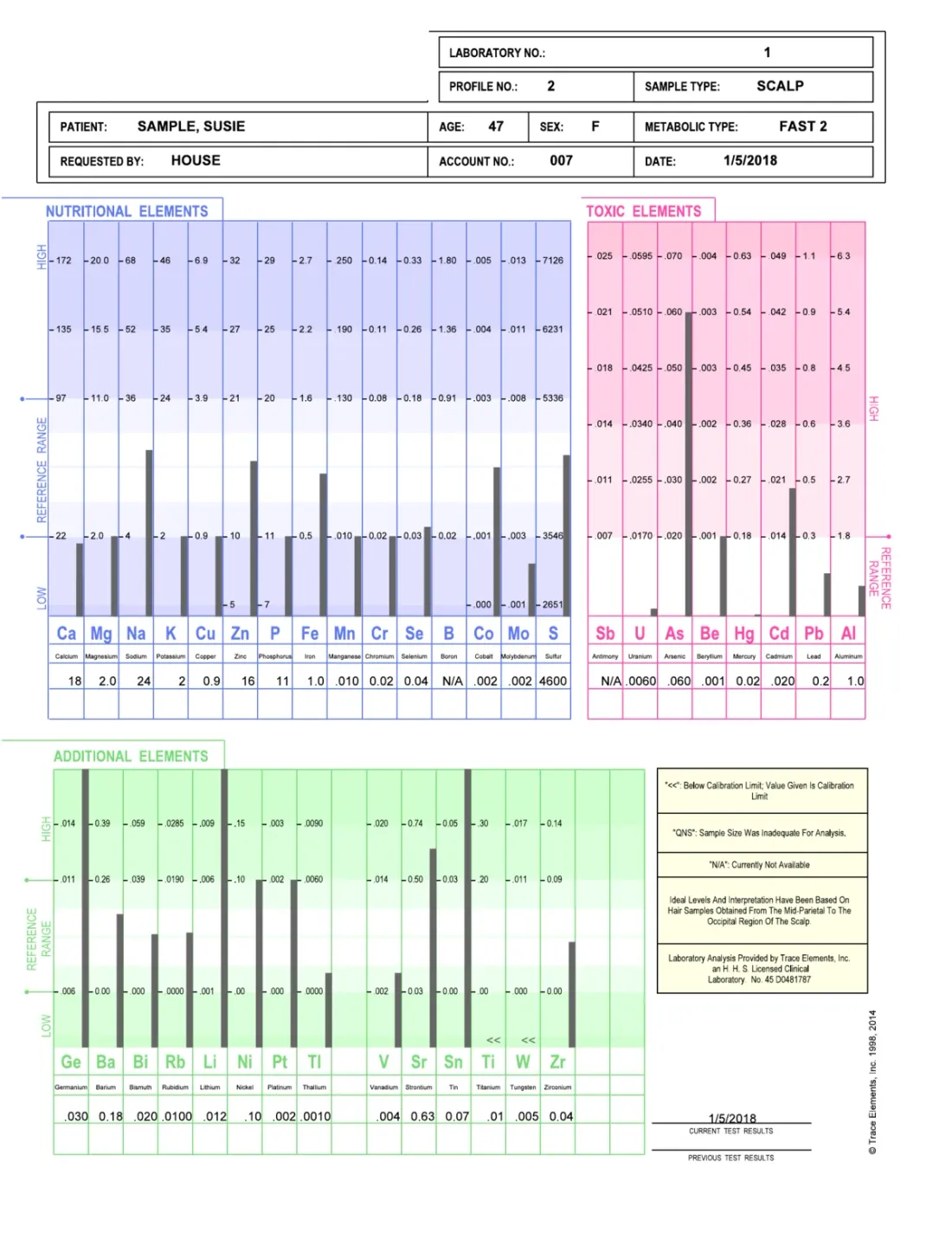
Worth knowing before it lands: the evaluation and the suggestions in it are produced from the sample alone. The laboratory has not seen your history, your medications or your symptoms, so what it sends is a starting point for a conversation rather than a plan to follow, and data of a kind that is easy to over-read, which is where most of the harm associated with this test comes from rather than from the test itself.
Reading the report is the part that matters, and it is a skill in its own right. Carmen Farrugia is the naturopath at Brunswick Health who works with mineral analysis, by phone or in a naturopathic consultation. She reads the report against your health history, medications and symptoms, and can talk through what the patterns across it may suggest about mineral balance, metabolism and your stress response. Where something in it warrants further testing, she can arrange blood or urine pathology, the pathology centre bills its own fees for that. Consultation fees apply and are separate from the cost of the test. The report is yours, so you are free to take it to any practitioner you choose.
Dogs and horses
Dogs and horses have their own version of this test, with their own collection instructions, their own health questionnaire and a slightly different element profile. The report goes to your vet, who is the person qualified to say whether it means anything for your animal.
Fees and cancellation
Current pricing is in the shop. Medicare does not cover hair mineral testing and most private health funds do not pay a benefit for it, although a naturopathy consultation to discuss the results may be claimable if naturopathy is on your extras cover. Check with your fund before ordering.
Cancellations before laboratory analysis begins attract a 20% fee. Once analysis has started the test cannot be refunded, because the laboratory's cost has already been incurred. If you are unsure whether this is the right test for your question, ask before you order.
Questions
Hair mineral testing, common questions
Sample collection, treated hair, turnaround, interpretation, cancellation and the limits of what the test can tell you.
What is hair mineral analysis?
Hair mineral analysis measures the concentration of minerals and metals deposited in a hair sample using mass spectrometry. A sample cut close to the scalp reflects roughly the last one to three months of growth, so unlike blood or urine, which show what is circulating now. It gives a record spread across that window. The report covers nutritional minerals such as calcium, magnesium, zinc, copper and selenium, a set of additional trace elements, and heavy metals including lead, mercury, arsenic, cadmium and aluminium.
Is hair mineral analysis a diagnostic test?
No, and this is the most important thing to understand before ordering it. Hair mineral analysis is a screening measurement, not a stand-alone diagnostic test. Many factors have to be read alongside the numbers, so it belongs inside a broader health assessment. It is not accepted in mainstream medicine as a way of diagnosing nutrient deficiency or heavy metal poisoning, and published studies have found identical samples sent to different laboratories returning different values and different recommendations. Treat the report as one piece of information a practitioner considers alongside your history, symptoms and any conventional testing, not as an answer on its own.
What if I have a known or suspected heavy metal exposure?
Say so when you order, because a hair test is the wrong tool to rely on for that on its own, occupational exposure, an old paint renovation, a contaminated water supply. The same goes for any symptom that is worrying you: bring it to a naturopathy consultation rather than waiting on a hair result. Clinically significant heavy metal exposure is confirmed on blood or urine testing, which is what treatment decisions are made from, and the naturopaths here can arrange that pathology, and will refer you on to a GP or specialist where a result calls for it. Pathology ordered by a naturopath goes through a private laboratory and is paid directly to it, without a Medicare rebate, separately from anything you pay here. There is also a lag worth knowing about: hair has to grow above the scalp before it can be cut, which takes roughly ten to fourteen days, so a single or very recent exposure may not be in the sample at all. Hair is the better tool for looking back across a longer period than for confirming one recent event. Do not use a hair result to rule out a poisoning, and do not delay assessment while a report is on its way.
How do I collect a hair sample?
Wash your hair with a plain shampoo first, rinse it well and let it dry, with no gel, oil or cream left in it. Then take small snips from several places across the back of the scalp, starting at the nape of the neck, cutting as close to the scalp as you can with clean stainless steel scissors, thinning scissors work well on short hair. Keep the 3cm closest to the scalp and discard the rest, and if your hair is shorter than 3cm keep all of it. Aim for about a tablespoon. The laboratory can work with as little as a teaspoon, enough to cover a 20-cent coin, but there is nothing to gain from sending the minimum and a short sample has to be collected again. Place it in a clean paper envelope or sachet, clearly labelled with your name, age, sex and sample type, no staples, clips, sticky tape, foil or plastic, and seal that inside a second mailing envelope so nothing spills when the outer one is opened. Foil is the one to watch: aluminium is among the elements measured, so it contaminates the sample with the thing being counted and the laboratory rejects it rather than reporting a false reading.
Does dyed, bleached or treated hair affect the result?
Yes, considerably, which is why untreated hair is required. Permanent colour, bleach, perms and straightening treatments alter the mineral content of the strand itself, and mineral-based or anti-dandruff shampoos, selenium sulfide and zinc pyrithione formulations especially, deposit the very elements being measured, which artificially increases those levels and skews the final result. The laboratory asks for hair freshly washed with a plain shampoo, rinsed well and free of gels, oils and creams. If your hair is coloured or chemically treated, the laboratory asks you to wait six to eight weeks and sample the fresh growth.
What if I do not have enough head hair?
Underarm or pubic hair can be used, but the laboratory treats it as a last resort rather than an alternative: body hair grows at a different rate, so the time window it represents is less certain, and its nutrient readings are less reliable than scalp hair. Scalp hair gives the clearest picture, and a thin sample taken from four or five places across the back of the head still beats body hair. If you do have to use it, note that on the envelope so the laboratory reads the result accordingly, and send one type only, because scalp and body hair cannot be analysed together.
How long does hair mineral testing take?
Your report is emailed 3 to 4 weeks from the day we receive your sample, so allow a few days for the post on top of that. Analysis starts once your sample, your completed health questionnaire and your payment are all in, those are steps one to four, in that order, and there is no kit to wait for before you begin, so the clock starts as soon as you decide to.
Do I need an appointment for hair mineral testing?
No. Nothing is posted out to you and there is no kit to wait for. You cut the sample at home, post it in, fill in the health questionnaire and pay, all without coming to the clinic. Clinic staff cannot cut the sample for you as part of a normal visit. If you would like help collecting it, or want the report interpreted, book a consultation, Carmen Farrugia is the naturopath at Brunswick Health who works with mineral analysis, in person or by telehealth. Consultation fees apply and are separate from the cost of the test.
What is the health questionnaire, and do I have to fill it in?
It is a short online health history, your medications and supplements, what your hair has had done to it, where on the body the sample came from, and what prompted you to test. It takes about ten minutes and it is required, because the laboratory reads your result against your history rather than against an average. It is step three of the four: prepare your sample, send it in, complete the questionnaire, then pay. The form takes you to payment when you submit it, and the one thing to get right is the name. Use the same one on the questionnaire and at the checkout, because that is how your form, your sample and your payment are matched to each other. If the card belongs to someone else, put your own name in at both ends.
How often should hair mineral testing be repeated?
There is no medical schedule for this, because it is not a monitoring test in the way a blood test is. If you are retesting to see whether something has changed, leave at least three months between samples, anything shorter and you are largely re-measuring the same period of growth, since the sample only represents the last one to three months anyway.
Is hair mineral testing covered by Medicare or private health insurance?
Medicare does not cover hair mineral testing. Private health fund coverage varies and most funds do not pay a benefit for the test itself, although a naturopathy consultation to discuss the results may be claimable if naturopathy is on your extras cover. Check with your fund before ordering.
Can you test my dog or horse?
Yes, dogs and horses have their own version of this test, with their own collection instructions, their own health questionnaire and a slightly different element profile. The report goes to your vet, who is the person qualified to say what it means for your animal; Brunswick Health cannot give veterinary advice or interpret an animal's results.
Can I cancel a hair mineral test after ordering?
Yes, before laboratory analysis begins, a 20% cancellation fee applies at that stage. Once the laboratory has started the analysis the test cannot be refunded, because the work and the laboratory's cost have already been incurred. If you are unsure whether the test is right for you, ask before you order rather than after.
Bookings
Start your hair mineral test
Cut the sample, post it in, fill in the questionnaire, then pay. Nothing is posted out to you and there is no kit to wait for, so you can start today.