
Chiropractic
Low back pain: what helps, and what to ignore
Most low back pain has no single cause, gets better, and does not need a scan. What the assessment looks for, and how long recovery usually takes.
Low back pain is the most common reason people book at this clinic, and the single most useful thing to know about it is also the least intuitive: in most cases there is no specific structure that can be confidently blamed, and that is good news rather than bad.
Most low back pain is “non-specific”, and that is a good sign
Around four in five episodes of low back pain are classified as non-specific. It means the assessment cannot pin the pain on one identifiable structure, not a disc, not a joint, not a nerve, not with any confidence.
That sounds like a failure of diagnosis. It is not. Non-specific low back pain carries a good recovery outlook, and the label exists because decades of trying to sub-classify it more precisely has not produced better treatment. The categories that do matter clinically are much simpler: is a nerve involved, is there any sign of serious pathology, and how much is this affecting what you can do.
The remaining minority does have a specific cause, nerve root irritation producing sciatica, age-related narrowing of the spinal canal, an inflammatory arthritis, a fracture. Each behaves differently on examination, which is most of what the assessment is separating out.
What the assessment is actually looking for
Three things, in this order.
Anything serious. A short set of questions and tests that screen for fracture, infection, inflammatory disease and cancer. These are uncommon, they present differently from mechanical back pain, and ruling them out early is the reason the history takes as long as it does.
Whether a nerve is involved. Pain travelling below the knee, numbness, pins and needles or weakness changes both the outlook and the treatment. Reflex, sensation and strength testing establishes it.
What provokes and what eases it. Which movements hurt, which help, what position you cannot tolerate, what you have stopped doing. This is what treatment is built from, and it is far more useful than a picture of your spine.
Why scans usually do not help
Disc degeneration appears on MRI in roughly a third of people in their twenties who have no symptoms at all, and that proportion climbs steadily with age. Disc bulges are similarly common in people who feel fine.
So a scan will almost always find something. The problem is that finding something is not the same as finding the cause, and being told your spine is degenerating tends to make people move less and worry more. Both of which are associated with worse outcomes, not better ones.
Imaging is worth doing when the result would change what happens next. That is a real threshold, and it is met often enough that this clinic writes X-ray referrals regularly, usually bulk billed when done at a bulk-billing centre. It is just not met by “I would like to know what is going on in there”, however reasonable that wish is.
Signs that need medical assessment before treatment
Most low back pain is not urgent. These are:
- Loss of bladder or bowel control, or numbness around the genitals, inner thighs or buttocks, that is an emergency department, today, not a clinic appointment
- Pain that followed a significant fall, crash or direct blow
- Fever, unexplained weight loss, or night pain that wakes you and will not settle in any position
- Progressive weakness in one or both legs, rather than pain alone
- New back pain with a history of cancer, osteoporosis or long-term steroid use
The practitioners here are trained to spot these, and screen for them at every first appointment. Anything that isn’t on this list is exactly the sort of thing the practitioners here see every day.
What treatment involves
Staying as active as you reasonably can. The best-evidenced advice and the hardest to follow, because the instinct is to protect the back by not using it. Modifying what you do for a week or two is sensible; stopping is not.
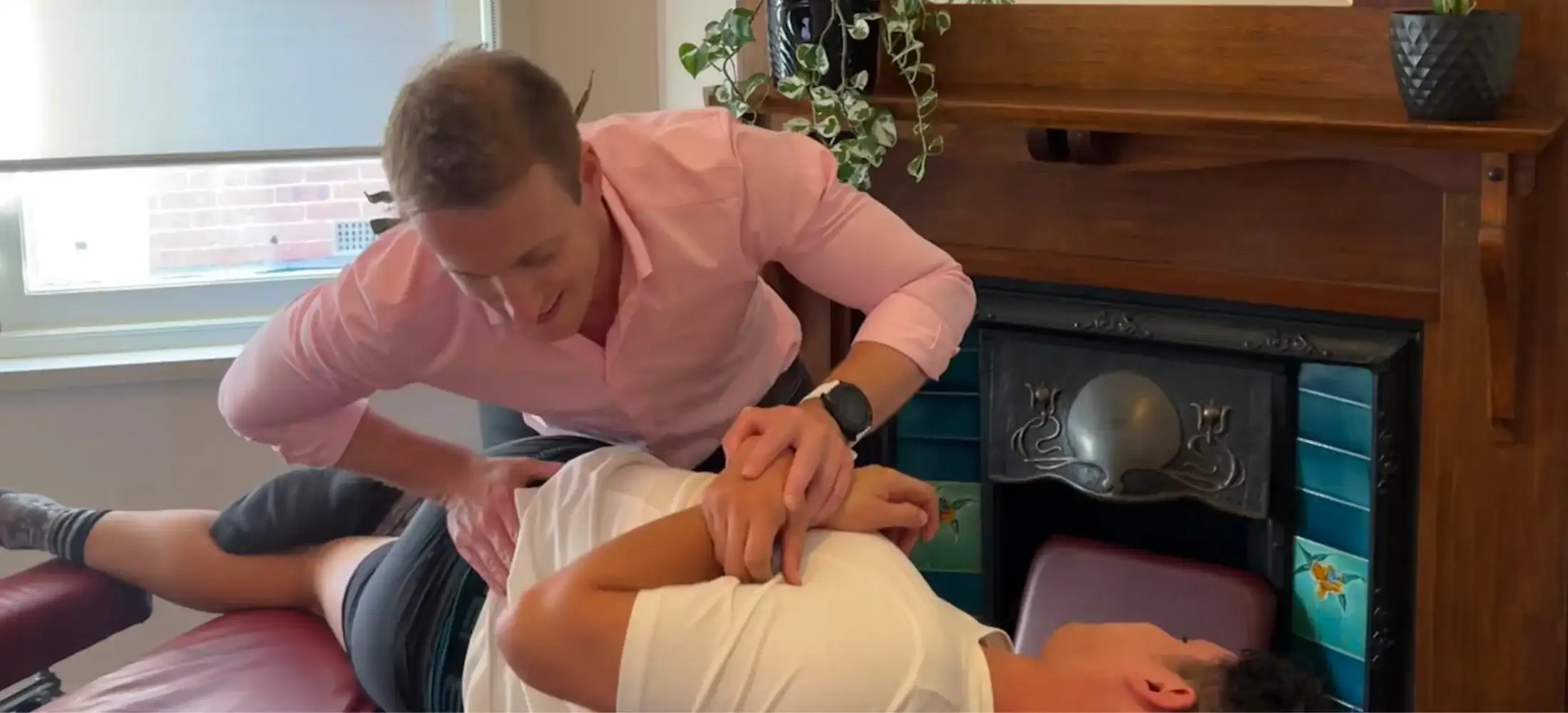
Hands-on treatment. Manual joint techniques and soft tissue work to the lower back, pelvis and the muscles that have tightened around the problem. The evidence supports short-term reduction in pain and improvement in movement, which is worth having when you are sore and cannot sit through a workday. What it does not do is put a spine back that was out of place.
Movement that is specific to you. Directional preference is real, repeated extension eases some people’s pain and worsens others’. Which applies to you is worked out by testing, not from a generic exercise sheet.
The boring load changes. How long you sit before standing, how you lift, how you sleep, how quickly you return to normal activity. Individually unremarkable, and collectively among the things most likely to stop it recurring.
How long it usually takes
Most acute episodes improve substantially within two to six weeks. Improvement is rarely linear, good days and bad days inside an improving trend is the normal pattern, and a flare in week three does not mean the plan is wrong.
Low back pain that has been present for months behaves differently. It is less predictable, it responds less dramatically to hands-on treatment alone, and the goal shifts from making it disappear to expanding what you can do without triggering it. That is a slower project and it is worth being told so at the start rather than discovering it at visit twelve.
If yours is not following the expected course after several weeks of appropriate treatment, that is information. It should prompt a reassessment, a referral, or a rethink, not more of the same at a higher frequency.
Chiropractic, physiotherapy, or both
Both professions manage low back pain and the emphasis differs. Chiropractic tends to lead with hands-on joint and soft tissue work; physiotherapy tends to lead with loading and progressive rehabilitation. Most low back pain benefits from some of each, and the sensible starting point depends on your presentation rather than on the sign on the door, someone who cannot get comfortable in any position needs different first steps from someone whose back is fine until the third set of deadlifts.
At Brunswick Health both work in the same building, so moving between them is a conversation rather than a new referral and a new waiting list.