
Brunswick Health
Does Medicare cover an MRI? Bulk billing, costs and who can refer
Medicare covers an MRI when a GP or specialist requests an eligible scan. When it's bulk billed, what the specialist route really costs, and faster options.
An MRI can be bulk billed when a GP or specialist requests a scan that meets Medicare’s criteria, and the imaging centre agrees to bulk bill it.
If your MRI is for one of three reasons, your GP can request it directly, so you can have it bulk billed without waiting to see a specialist:
- Head: seizures or ongoing headaches
- Neck: a pinched nerve or an injury
- Knee: a recent traumatic injury, if it won’t fully straighten or the ACL may be torn, for ages 16 to 49
For any other MRI, including the lower back, shoulder and hip, is a bulk-billed scan worth the wait? Medicare only covers it if a specialist requests it. That means paying for two specialist appointments, which Medicare only partly covers, and waiting weeks to be seen, so it takes longer to confirm or rule out what’s wrong. Once the specialist’s fees are added, the total is often about the same as a private MRI, which your chiropractor, physiotherapist, podiatrist or GP can refer you for directly. (See the worked example below that compares the two.)
Bulk billed means the imaging centre bills Medicare directly, so there are no out-of-pocket expenses for the eligible service. If the centre charges you instead, Medicare pays you back 85% of the Medicare fee.
Who can refer you for which scan
| Scan | Body area | Who can refer you (with Medicare) | Best for |
|---|---|---|---|
| X-ray | Neck, back, hip, pelvis | Chiropractor, physiotherapist or GP | Bones: fractures and arthritis |
| X-ray | Foot, ankle, leg, knee | Podiatrist or GP | Bones: fractures and arthritis |
| Ultrasound | Foot and ankle | Podiatrist or GP | Tendons and soft tissue: Achilles, plantar fascia |
| Ultrasound | Shoulder and other areas | GP | Tendons, muscles and bursae, seen moving |
| MRI | Head: seizures or ongoing headaches Neck: a pinched nerve or an injury Knee: a recent traumatic injury, ages 16 to 49 only |
GP or specialist | Discs, nerves, ligaments, cartilage |
| MRI | Lower back, shoulder, hip and most other areas | Specialist only | Discs, nerves, ligaments, cartilage |
Your options for an MRI
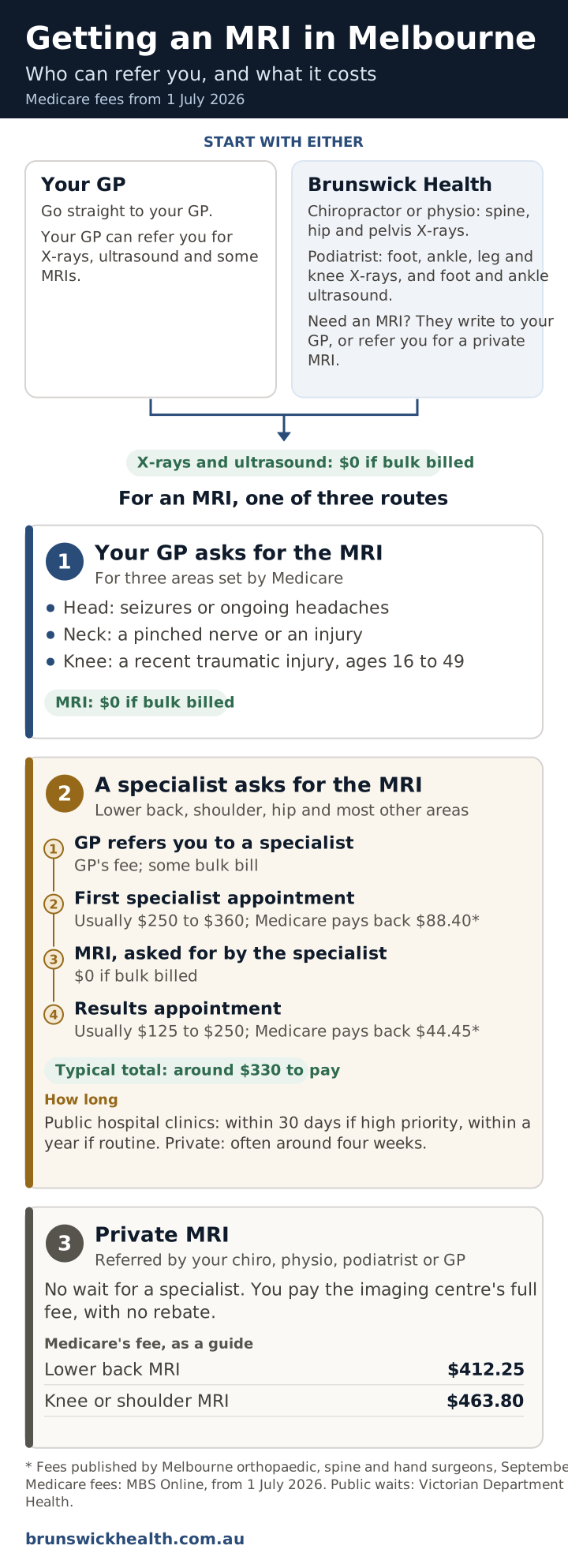
You can go to your GP directly, or start with an assessment at Brunswick Health. If you start here and your practitioner thinks an MRI would change your care, they can write to your GP with their findings and the reason for the scan, or refer you directly for a private MRI. From there, it’s one of three routes.
| Route | Which scans | What you pay | How long |
|---|---|---|---|
| 1. Your GP asks for it | A GP can only request an MRI for these three: Head: seizures or ongoing headaches Neck: a pinched nerve or an injury Knee: a recent traumatic injury, if it won’t fully straighten or the ACL may be torn. You must be aged 16 to 49. |
The GP’s fee. The MRI is $0 if bulk billed. | Set by the GP and the imaging centre |
| 2. A specialist asks for it, such as an orthopaedic surgeon. Your GP refers you. | Lower back, shoulder, hip and most other areas | Specialist fees (below). The MRI is $0 if bulk billed. | Public hospital clinics: within 30 days if high priority, within a year if routine. Private: often around four weeks for a first appointment. |
| 3. Private MRI, referred by your chiropractor, physiotherapist, podiatrist or GP | Any | The imaging centre’s full fee, with no rebate | As soon as the imaging centre can fit you in |
What decides Medicare cover is what the examination findings indicate. Having had pain for a long time, or a scan before, doesn’t qualify or disqualify you on its own. And an eligible scan is only $0 if that imaging centre bulk bills it; some charge a gap, so ask when you book.
Specialist route or private MRI? A worked example
A bulk-billed MRI isn’t the same as a free one. On the specialist route you pay towards two specialist appointments, and you wait. Here’s how the two routes compare for an adult with sciatica who needs a lower back MRI, which a GP can’t request with a Medicare rebate.
| Specialist route (Medicare) | Private MRI | |
|---|---|---|
| Referral | GP appointment: the GP’s fee, or $0 if bulk billed | Your chiropractor, physiotherapist, podiatrist or GP refers you directly |
| First specialist appointment | Usually $250 to $360. Medicare pays back $88.40, leaving about $160 to $270 to pay. | No private MRI fee if bulk billing is requested by the specialist. |
| MRI | $0 if the imaging centre bulk bills | The imaging centre’s full fee, with no rebate. At Medicare’s own fee, that’s $412.25. |
| Results | Follow-up specialist appointment: usually $125 to $250. Medicare pays back $44.45, leaving about $80 to $205 to pay. | Your chiropractor, physiotherapist, podiatrist or GP discusses your MRI results at your next appointment |
| Typical total to pay | Around $330, and anywhere from about $240 to $480 depending on the specialist, plus your GP appointment if it isn’t bulk billed | About $412, depending on the imaging centre, plus your first chiropractor, physiotherapist or podiatrist appointment (see fees), or your GP appointment if it isn’t bulk billed |
| Time | Often around four weeks to see the specialist, then the MRI, then a results appointment | As soon as the imaging centre can fit you in |
Specialist fees vary, so check with their rooms when you book, and ask the imaging centre for its price before a private MRI scan. The question to weigh up is how long you can wait, and whether the results would change your treatment sooner.
Jake and Jill: two ways to the same lower back MRI
Jake and Jill both need a lower back MRI, and both have a GP who bulk bills. Jake takes the specialist route, with a specialist who charges $360 for the first appointment and $200 for the follow-up. Jill’s GP refers her straight for a private MRI.
| Jake: specialist route | Jill: private MRI | |
|---|---|---|
| GP appointment | $0 (bulk billed) | $0 (bulk billed) |
| First specialist appointment | $360, less $88.40 from Medicare = $271.60 | Her GP may or may not refer her to a specialist afterwards, depending on the MRI findings. |
| MRI | $0 (bulk billed) | $412.25, no rebate (at Medicare’s own fee) |
| Follow-up specialist appointment | $200, less $44.45 from Medicare = $155.55 | Not needed; her GP or practitioner goes through the results |
| Total to pay | $0 + $271.60 + $0 + $155.55 = $427.15 | $0 + $412.25 = $412.25 (excludes the cost of a specialist, should she need one) |
| Time to results | Often around four weeks to see the specialist, then the MRI, then the follow-up | As soon as the imaging centre can fit her in |
The total cost depends on what happens next and whether you need to see a specialist.
If no specialist appointment is needed, the overall costs may be comparable, depending on the MRI fee and any Medicare rebate.
Jill may have her MRI first through her GP and then see a specialist if needed. Jake may see a specialist first, have the MRI arranged, and then need another appointment to discuss the results.
If Jill also needs a specialist, her total cost will include both the MRI and the specialist appointment. Jake may also have the cost of a second specialist appointment to discuss the MRI results.
There can also be a difference in waiting time. If Jill has her MRI before seeing the specialist, the specialist can review the results at the first appointment rather than arranging the MRI and asking her to come back later.
When comparing the options, consider the total cost, number of appointments, time off work and waiting time, not just the cost of the MRI.
Medicare fees for common MRIs
These are the fees Medicare sets for each scan. Medicare only pays towards an MRI when a GP or specialist requests it and the scan meets Medicare’s criteria. Without that referral, there’s no rebate and you pay the imaging centre’s full fee, which can be higher than these.
Private health insurance doesn’t help with either route. Health funds can’t pay towards Medicare services outside hospital, so they don’t cover specialist appointment fees or an MRI you pay for privately.
| MRI | Medicare fee | Medicare pays back on an eligible scan, if the centre charges you (85%) |
|---|---|---|
| Lower back, for sciatica or narrowing of the spinal canal | $412.25 | $350.45 |
| Knee or shoulder | $463.80 | $394.25 |
| Head | $463.80 | $394.25 |
Sources: Medicare fees from MBS Online, from 1 July 2026. Specialist fees are the range published by Melbourne orthopaedic, spine and hand surgeons, checked 27 September 2026. Public waiting times from the Victorian Department of Health.
How it works at Brunswick Health
When a scan is clinically justified, your practitioner at Brunswick Health arranges the right referral for you:
- X-rays: your chiropractor, physiotherapist or podiatrist refers you directly to a radiology centre that bulk bills. Your podiatrist can also refer you directly for a foot or ankle ultrasound.
- An MRI your GP can request (head, neck, or a knee after a recent traumatic injury): your practitioner writes to your GP with their findings and asks for the MRI.
- An MRI that needs a specialist (lower back, shoulder, hip and most other areas): your practitioner writes to your GP with their findings, so your GP can refer you to the right specialist.
- A private MRI: if you’d rather not wait, your practitioner can refer you directly for a private MRI, paid in full to the imaging centre.
When the results come back, your practitioner explains them in plain language and what they mean for your treatment.
Do you need an MRI?
An MRI is most useful when its result would change your treatment. Your practitioner recommends one when that’s the case, for example:
- a suspected fracture, or a suspected tear in a ligament, tendon or cartilage
- nerve symptoms that are getting worse, such as spreading numbness or weakness
- symptoms that aren’t improving as expected with treatment
- when surgery or an injection is being considered, so the surgeon can see exactly what’s there.
For everyday back and neck pain, an MRI often isn’t needed straight away, and the reason is how much an MRI shows. It picks up changes such as disc bulges and wear and tear that are very common in people with no pain at all. About a third of people in their twenties have disc changes on an MRI, and the number rises with age.
What matters is whether the MRI matches what your practitioner finds when they examine you. A disc bulge that lines up with your symptoms, such as leg pain following the path of the nerve it’s pressing on, is very likely to be the cause. A small bulge with no matching pain or symptoms usually isn’t, but it’s still worth knowing about: it tells your practitioner that disc is already compromised, so they’ll keep an eye on it and show you how to protect it.
Whether you need an MRI later, or more invasive treatment such as an injection or surgery, depends on how you present at your first visit and how you respond to treatment. Your practitioner reviews both as your care goes on. For many people, conservative care such as hands-on treatment, exercise and advice is enough to improve their symptoms. When it isn’t, your practitioner arranges the next step.
After an injury
If you’ve had a fall, a knock or another injury and you’re worried something may be broken, book an examination. Your practitioner can assess you, refer you for an X-ray, and manage many fractures, including fitting a cast where the bone hasn’t moved out of place.
A few symptoms need a hospital emergency department rather than a clinic appointment: new bladder or bowel changes with back pain, weakness in the legs that’s getting worse quickly, or a fever with spinal pain.
To have your pain assessed and find out whether you need a scan, book with a chiropractor, physiotherapist or podiatrist at Brunswick Health.
MRI in Melbourne at a glance
Booking an assessment at Brunswick Health
A first appointment with a chiropractor or podiatrist is $125, and with a physiotherapist $130. It claims on any extras policy that includes that service, and HICAPS is on site, so you pay only the gap on the day.