
Chiropractic
Posture and back pain: what the evidence actually shows
Bad posture is blamed for most back pain, and the research does not support that. What does matter, and what to do instead of sitting up straight.
Posture is the most commonly blamed cause of back and neck pain, and the least well supported. That is an uncomfortable thing for a clinic to say, and it leads somewhere more useful than the usual advice does.
What the research shows
Studies comparing measured spinal posture with the presence of back or neck pain find weak and inconsistent relationships. People with pronounced forward head posture often have no neck pain. People with textbook alignment often do. Large reviews looking for a link between sitting posture and low back pain have not found a consistent one.
Nor does correcting posture reliably fix pain. Interventions that change measured alignment do not produce corresponding changes in symptoms.
None of that means how you sit is irrelevant. It means the model. That there is a correct position and pain comes from deviating from it, does not describe what is going on.
A better model: position over time
What does associate with discomfort is how long a position is held.
Muscles maintaining a low-level contraction for hours become uncomfortable regardless of the exact angle. Tissues held at end range accumulate load. Sitting perfectly upright for four hours is not obviously better than slouching for four hours; both are four hours in one position.
This reframes the advice in a way that actually works. “Sit up straight” asks you to sustain a different fixed position, which reproduces the problem in a new shape, and it is effortful, which is why nobody keeps it up past Tuesday. “Change position often” addresses the mechanism.
The clinical shorthand: the best posture is the next one.
The unhelpful side of posture advice
There is a cost to telling people their spine is misaligned, fragile, or out of place, beyond the fact that it is usually not true.
Believing your back is damaged and vulnerable is associated with worse outcomes in back pain, more fear of movement, more avoidance, more disability, and longer recovery. The language used about someone’s spine measurably affects how they do.
So there is a real problem with a scan report describing “degeneration” in a 45-year-old, or a practitioner describing a spine as crumbling. Disc degeneration on imaging is present in roughly a third of people in their twenties with no symptoms at all, rising steadily with age. It is a normal age-related finding, closer to grey hair than to disease.
What does matter
Movement variety. Getting up, changing position, walking. Frequency beats duration, a minute every half hour beats twenty minutes at lunch.
Total load. How much sitting overall, how much lifting, how much repetitive work. Volume matters even when position does not.
Physical capacity. Being strong enough for what you ask of yourself. This is where the evidence is genuinely good: exercise reduces both the incidence and the recurrence of back pain, more reliably than any postural intervention.
Sleep, stress and mood. All three influence pain perception and tissue tolerance, and all three tend to be worse in the periods when someone’s back is worse. Not a way of saying the pain is in your head, a way of saying that pain is influenced by more than mechanics.
A workstation that allows variety. Not one correct configuration, but a setup that does not force you into a narrow range of positions for hours.
Where hands-on treatment fits
Manual therapy, joint techniques, soft tissue work, has reasonable evidence for short-term reduction in pain and improvement in movement in acute and subacute back pain. That is worth having when you are sore, and it is what most people come in for.
What it does not do is realign a spine that was out of place, and any treatment plan built around repeatedly putting something back is worth asking questions about. Treatment reduces symptoms and improves movement; what changes the pattern is what you do between appointments.
What we will actually tell you
At an assessment you will get a plain-language explanation of what was found, and you will not be told your spine is crumbling or that you have the posture of someone twice your age.
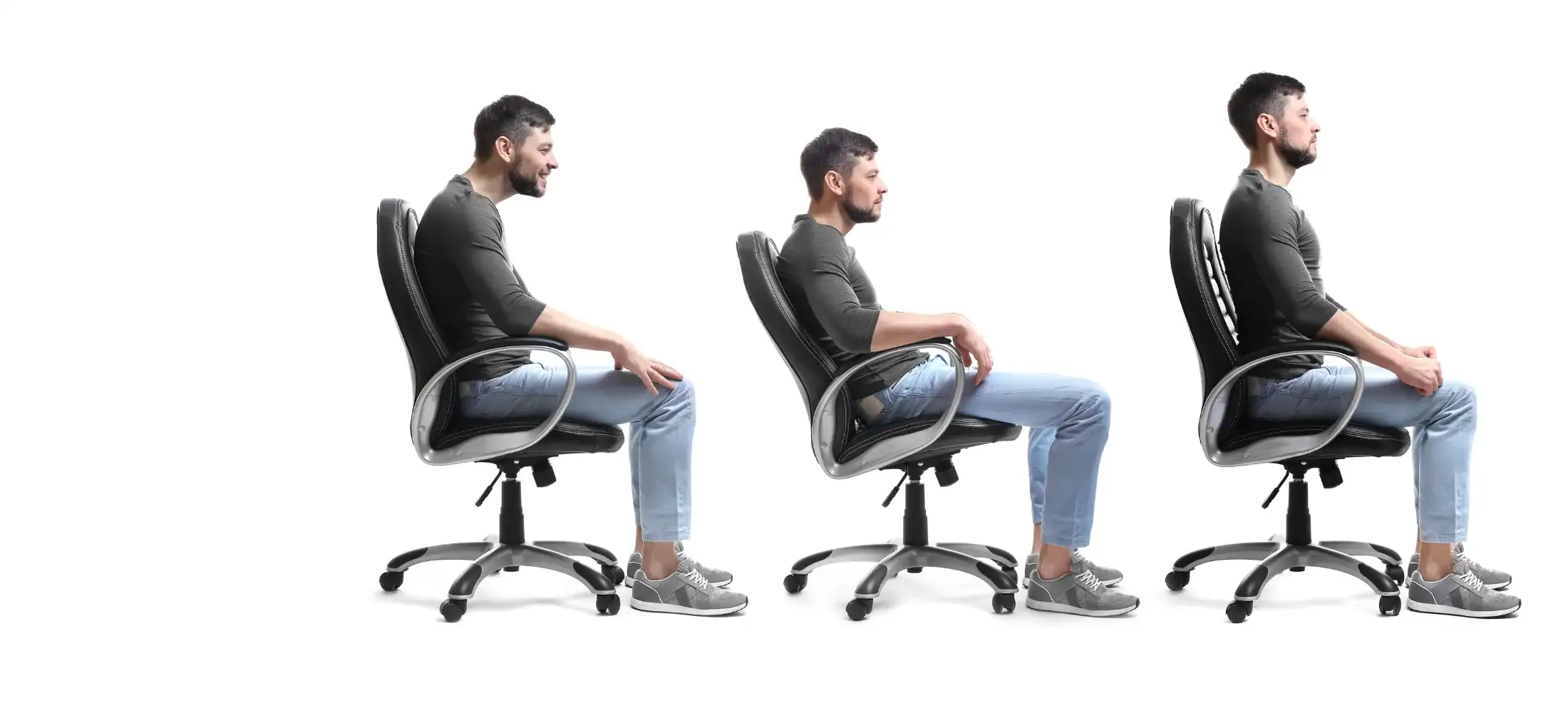
You will get specifics, how long you are sitting before you move, what your workstation is forcing you into, what strength work would help, rather than a diagram of a person sitting at a right angle.
And if the assessment suggests the problem is capacity rather than joint restriction, you will be told that, including when the physiotherapist in the same building is the better person for it.