
Podiatry
Corns, calluses and hard skin
Why corns come back after they are removed, what actually stops them, and why the tools sold to treat them at home are the ones most likely to cause harm.
Hard skin is not a flaw in the foot. It is the foot doing exactly what skin does when it is loaded repeatedly: thickening to protect what is underneath. The problem is that past a certain point the protection becomes the thing that hurts, and a corn pressing into the tissue beneath it can make a normal day’s walking genuinely unpleasant.
Corn or callus
The two are the same process at different scales, and the distinction matters because it points at different causes.
| Callus | Corn | |
|---|---|---|
| Shape | Broad, diffuse area of thickening | Small, focal, with a cone-shaped core pressing inwards |
| Where | Ball of the foot, heel, under the big toe joint | Tops of toes, between toes, weight-bearing points |
| Pain | Often none, an ache or a burning feeling under load | Sharp, localised, worse with direct pressure |
| Usual cause | Broad areas of high pressure over time | A specific point of pressure, often a bone against a shoe |
A soft corn between the toes is the same thing kept damp. It appears white and macerated rather than hard, and it comes from two toes pressing against each other in a shoe with no room across the front.
Why removal alone is not the treatment
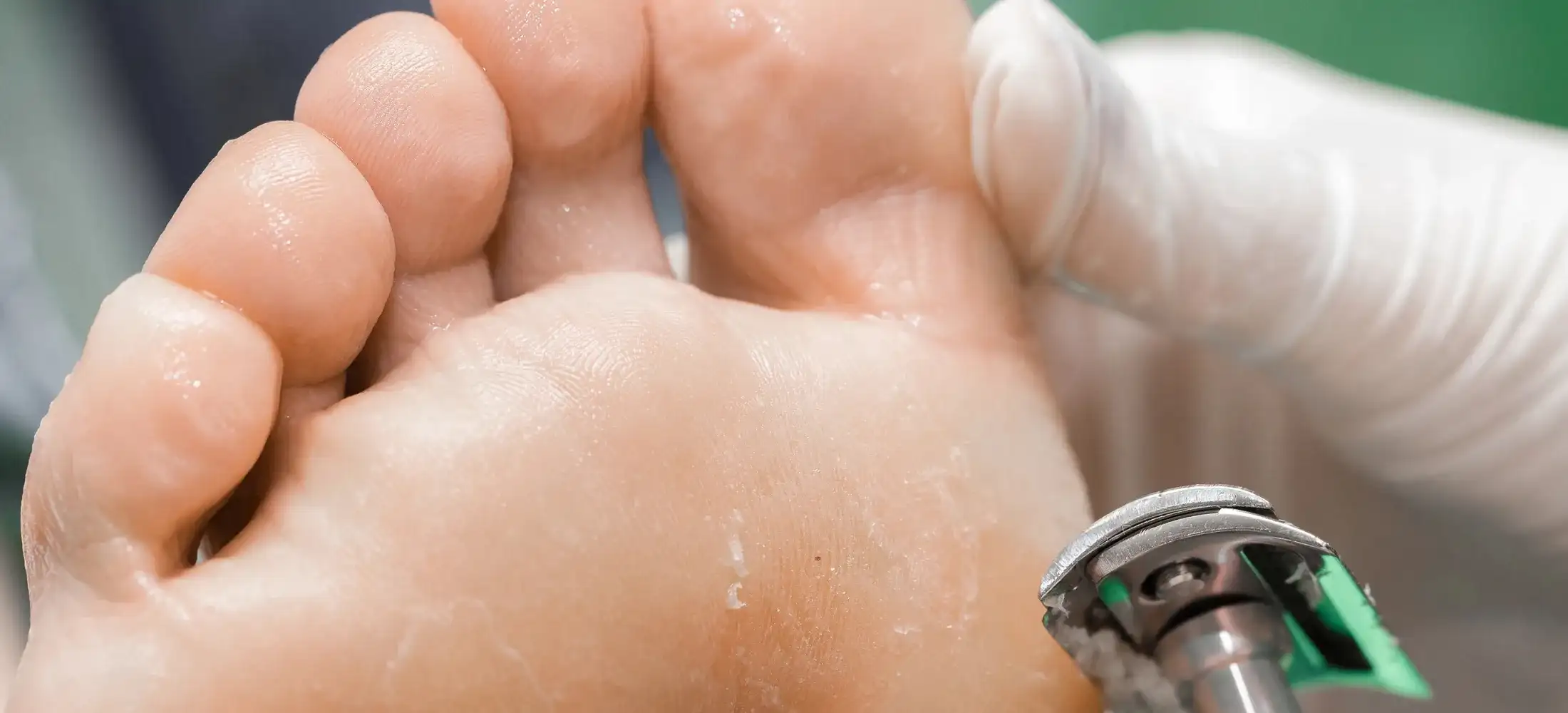
Paring a corn back is painless and the relief is immediate, because what is removed is dead tissue with no nerve supply. That part is straightforward.
What decides whether it returns is the pressure that built it. So the appointment does two things: the hard skin is removed, and the reason it is there gets identified. That is usually one of a short list:
- Footwear that is too narrow or too shallow across the front, the most common single cause, and the cheapest to fix
- A toe that has changed shape, so its knuckle now sits against the top of the shoe. Hammer toes and bunions both do this
- Uneven load through the forefoot, where one metatarsal head takes more than its share
- A gait pattern that loads one part of the foot repeatedly, which is where a biomechanical assessment and orthoses can change something the shoe alone cannot
- Reduced fat padding under the ball of the foot, which is a normal part of getting older
Padding, offloading and a change of shoe deal with most of it. Where the load pattern is the driver rather than the shoe, an orthotic device can redistribute it.
Cracked heels
Deep fissures around the heel margin are a related problem with a different mechanism: dry, thickened skin at the edge of a weight-bearing pad splits under load rather than compressing. The thickened rim is reduced first, because emollients applied over hard skin do not reach the skin that needs them. After that it is a matter of a urea-based cream used consistently and something with a closed back where possible.
A crack that is bleeding, weeping or painful to stand on is worth having looked at rather than managed at home, since a split in the skin of a heel is an open door for infection.
The tools worth avoiding
Almost every foot injury caused by home treatment comes from one of two things.
Medicated corn pads and paints. The active ingredient is salicylic acid, and it has no way of distinguishing the corn from the healthy skin around it. It thins both. A corn that was uncomfortable becomes an ulcer that is not, and the person least likely to notice is the person with reduced sensation.
Blades. Corn planes, razors and craft knives take living tissue along with the dead, and the sole of the foot is a poor place to start an infection. A pumice stone used gently on a callus after a shower is fine. Anything with an edge is not.
If you have diabetes, reduced circulation or reduced feeling in your feet, both categories are off the table entirely, and so is waiting, if the skin has already broken. Diabetic foot checks covers why the margins are narrower.
Routine care, and who it is for
A large share of this work is simply ongoing maintenance for people who cannot manage their own feet comfortably: arthritic hands that cannot grip clippers, a back that does not bend that far any more, eyesight that makes it unwise, a pregnancy in the way, or nails too thick to cut with anything domestic.
It is done in a treatment room with sterilised instruments by a registered podiatrist, typically every six to twelve weeks, and it is the same appointment often advertised elsewhere as a medical pedicure. See fees and health funds for what it costs and how it claims, or book a podiatry appointment directly.