
Physiotherapy
Shockwave therapy: what it is and when it helps
Shockwave therapy for stubborn tendon problems, jumper's knee, plantar fasciitis, tennis elbow, Achilles pain. What the evidence supports.
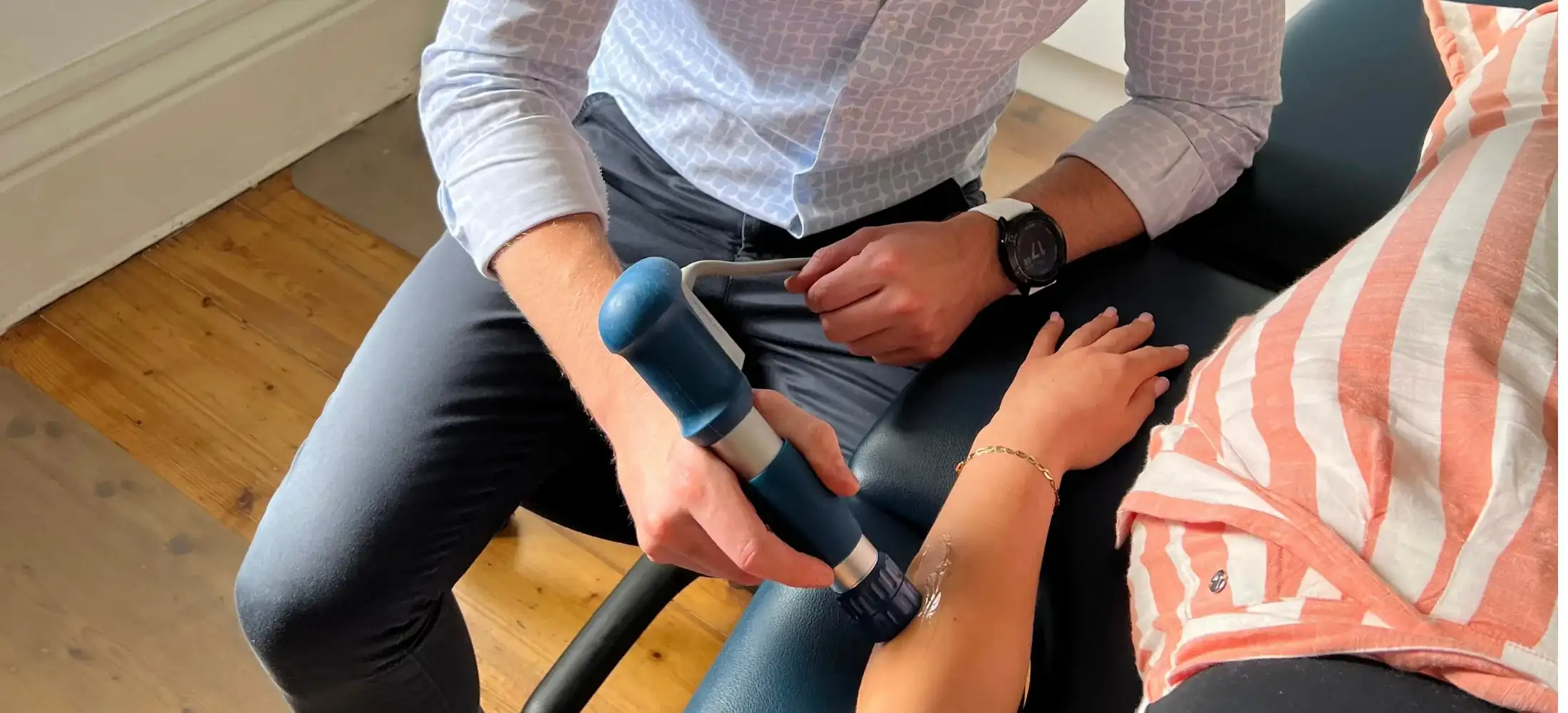
Shockwave therapy, properly, extracorporeal shockwave therapy, delivers pulses of acoustic energy into tissue through a handpiece pressed against the skin. It is available at Brunswick Health and is used mainly for tendon problems that have not settled with hands-on treatment and loading alone.
It is worth being precise about what it does, because it is frequently oversold.
What it is
A device generates rapid pressure waves and transmits them into the tissue through gel, in the same general way an ultrasound probe transmits sound. The waves are much higher energy than diagnostic ultrasound and are delivered as discrete pulses.
Two types exist. Radial shockwave disperses energy outward from the applicator and suits more superficial structures. Focused shockwave concentrates energy at a set depth and suits deeper targets. Most clinic devices, including this one, are radial.
What it is thought to do
The mechanisms are not fully settled, and any explanation offered with complete confidence should be treated cautiously. What the evidence points to:
- Stimulating a healing response. Chronic tendinopathy is a failed healing response. The tissue has stalled. Shockwave appears to restart the biological process, promoting new blood vessel formation and cellular activity.
- Reducing pain signalling. Effects on nerve endings in the treated area, which is likely why relief sometimes precedes any structural change.
- Breaking down calcification. Where calcific deposits are present, particularly in the shoulder, shockwave has reasonable evidence for reducing them.
Where the evidence is reasonable
- Plantar fasciopathy that has not responded to several months of loading and footwear change
- Calcific rotator cuff tendinopathy, one of its better-supported uses
- Patellar tendinopathy (jumper’s knee)
- Mid-portion Achilles tendinopathy, alongside a loading programme
- Lateral epicondylalgia (tennis elbow)
- Greater trochanteric pain syndrome at the outside of the hip
The consistent theme is chronic tendon problems that have already had a fair trial of appropriate loading. That is the population the studies are done in, and it is the population where it is worth offering.
Where something else works better
Knee osteoarthritis. People often arrive asking about shockwave for arthritic knee pain, and the evidence there is far weaker than for tendinopathy. Strength work, load management and weight where relevant remain the things that change arthritic knee pain.
As a first treatment. Most tendon problems respond to loading and load management. Shockwave is for the cases that have not, after a genuine attempt.
Instead of a loading programme. This is the most common way it disappoints. Shockwave appears to help tissue respond; it does not build capacity. Used without rehabilitation, symptoms often return.
Certain contraindications. It is not used over open growth plates in children, over a pregnant abdomen, in areas of infection or malignancy, in people on anticoagulant therapy, or where a bleeding disorder is present. These are checked before treatment.
What a session is like
Ten to fifteen minutes. Gel is applied and the handpiece is worked over the area at a set intensity and pulse rate. It is uncomfortable, a strong tapping or drumming sensation, sometimes sharp over the most tender spot, and intensity is adjusted to what you can tolerate.
Some soreness for a day or two afterwards is normal and expected. A short-lived increase in symptoms is common and is not a sign the treatment has failed.
Anti-inflammatory medication is usually avoided around treatment, on the reasoning that the point is to provoke a healing response rather than suppress it.
How many sessions
Typically three to six, once a week. Improvement is generally assessed at around the fourth. If nothing at all has changed by then, more sessions are not usually the answer, revisiting the diagnosis is.
A session at Brunswick Health is priced on the fees page, delivered by a chiropractor, physiotherapist or podiatrist depending on the problem, and it claims on any extras policy that includes that profession with the appropriate item code.
The honest summary
Shockwave is a useful adjunct for stubborn tendinopathy with reasonable evidence behind it in specific conditions. It is not a cure, it is not a substitute for rehabilitation, and it is not appropriate for every painful joint.
If you are being offered it as the whole treatment plan rather than as part of one, that is worth asking about.